


Nature-related Disclosures (TNFD)
 Share
Share- Disclosure in Line with the Recommendations of the TNFD
- General Requirements
- Governance
- Strategy
- 1. Analysis of Nature-Related Issues Across the UACJ Group Entire Value Chain
- 2. Analysis of Nature-Related Issues at Manufacturing Sites and Identification of Priority Locations
- 3. Setting the UACJ Group's Strategy and Targets
- Risk and Impact Management
- Metrics and Targets
- Specific Initiatives of the UACJ Group
Disclosure in Line with the Recommendations of the TNFD
In accordance with the recommendations of the Taskforce on Nature-related Financial Disclosures (TNFD), companies are required to undertake initiatives and disclose information regarding the conservation of natural capital and biodiversity. UACJ Group fully recognizes that our business activities not only benefit from the natural environment but also exert an environmental impact on it. We are committed to reducing this environmental impact while leveraging our unique capabilities to contribute to the conservation, restoration, and regeneration of nature. Concurrently, we will progressively disclose our status and initiatives toward realizing a nature-positive world in accordance with the TNFD framework.
General Requirements
The TNFD sets out six "general requirements" to be applied across all disclosures. UACJ Group's approach to each requirement is as follows.
1. Application of Materiality
In preparing this disclosure, we adopted a double materiality approach—focusing on both financial materiality, which assesses the effects on the UACJ Group's financial statements, and impact materiality, which assesses the Group's impacts on nature.
2. Scope of Disclosures
For the UACJ Group's core aluminum products manufacturing business, we have defined the scope of disclosure for our dependencies and impacts on nature to encompass the upstream value chain (from bauxite mining to virgin aluminum smelting), direct operations (primary alloy and product manufacturing), and the downstream value chain (including transportation and subsequent manufacturing processes).
3. Location of Nature-Related Issues
Recognizing that nature-related issues are highly location-specific, we selected 49 major business sites across the UACJ Group. We identified priority locations by assessing local natural characteristics and nature-related risks based on site data.
4. Integration with Other Sustainability-Related Disclosures
This report exclusively discloses nature-related information aligned with the TNFD recommendations. The UACJ Group already conducts disclosures based on the TCFD recommendations, which are available separately on our corporate website. At the UACJ Group, analyses and disclosures related to TNFD and TCFD, as well as the promotion and disclosure of other sustainability-related initiatives, are conducted within the Department in charge of promoting Sustainability, taking their mutual impacts into consideration. Moving forward, we are considering integrated reporting to clarify their connections.
5. Time Horizons Considered
We evaluated nature-related risks and opportunities from a medium- to long-term perspective (spanning from 2030 to 2050). The core global disclosure metrics reflect data from fiscal 2025 (April 1, 2025, to March 31, 2026).
6. Engagement of Indigenous Peoples, Local Communities and Affected Stakeholders in the identification and assessment of the organization's nature-related issues
Understanding the critical importance of co-creating value with diverse stakeholders—including shareholders, customers, business partners, employees, and local communities—the UACJ Group engages in appropriate multi-stakeholder collaboration.
Furthermore, we have identified "Respect for Human Rights" as a core sustainability materiality and established the " UACJ Group Human Rights Basic Policy." This foundational policy is rigorously applied in identifying nature-related issues and implementing corresponding countermeasures.
Governance
To drive our Nature Positive initiatives, we have established the Environment Committee, chaired by the President. As a dedicated subordinate body under this committee, we formed the Nature Positive Working Group (WG). The findings and activity outcomes of the WG are reviewed by the Environment Committee and the Corporate Management Committee, and are subsequently reported to the Board of Directors for final resolution and approval.
Strategy
The UACJ Group has adopted the LEAP approach recommended by the TNFD.
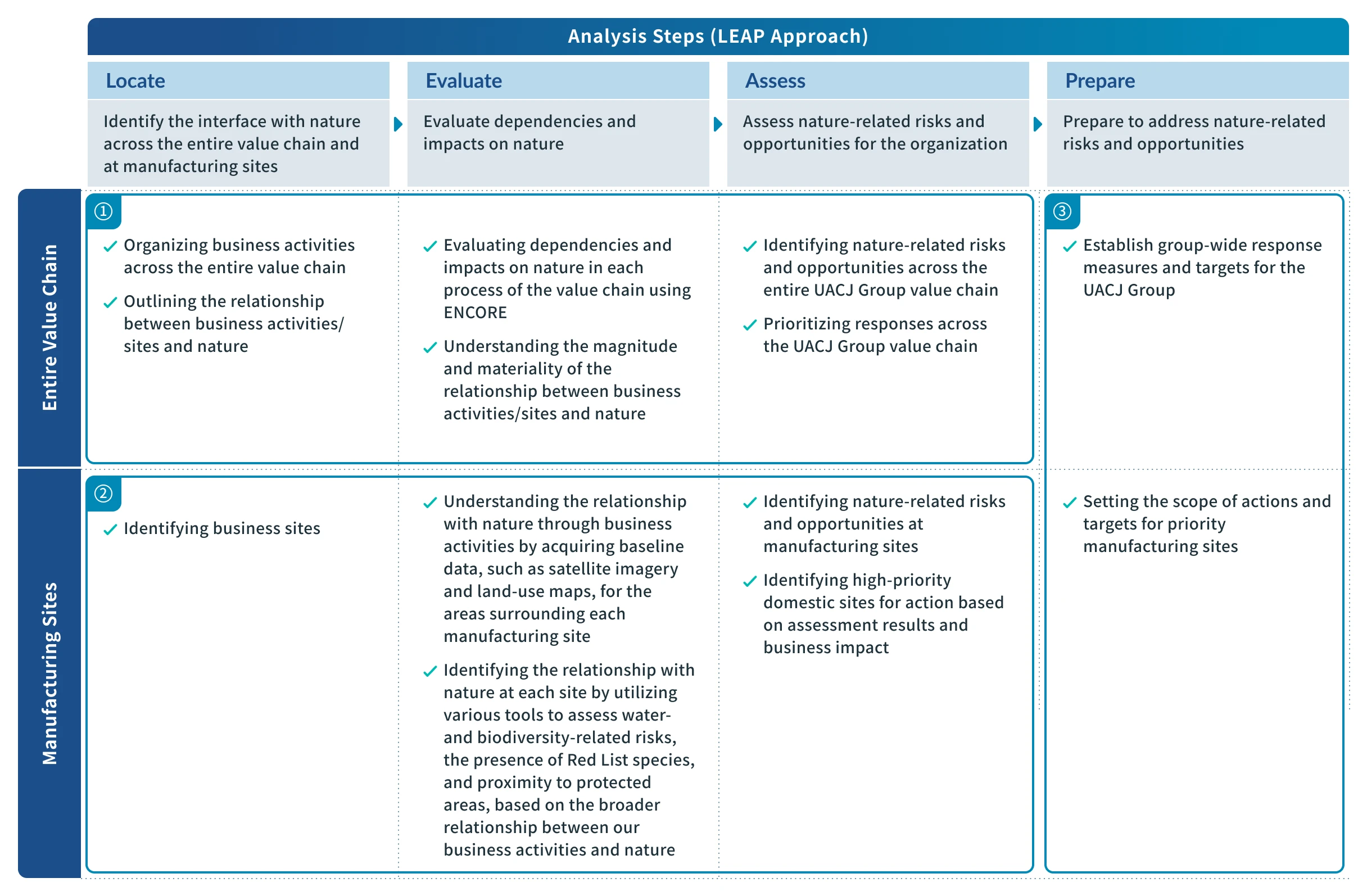
Developed by the TNFD, the LEAP approach is an integrated framework designed to assess nature-related issues—including an organization's interfaces with nature, dependencies, impacts, risks, and opportunities. The process comprises four phases: Locate, Evaluate, Assess, and Prepare.
In accordance with the LEAP approach, the UACJ Group analyzed and evaluated its nature-related dependencies, impacts, risks, and opportunities to formulate our strategic responses.
By applying the LEAP approach from two distinct perspectives—across the entire value chain and at the site level of our direct operations—we have clearly identified our nature-related issues.
By applying the LEAP approach from the two perspectives (1) and (2) below, we have identified our nature-related issues and established our strategies and targets.
1. Analysis of Nature-Related Issues Across the UACJ Group's Entire Value Chain
- By taking a comprehensive view of the relationship between the UACJ Group and nature, we analyzed our dependencies and impacts from the upstream to the downstream of the value chain to prioritize nature-related risks, opportunities, and corresponding responses.
- Based on the results of the dependency and impact analysis, we assessed the nature-related risks and opportunities for the UACJ Group.
2. Analysis of Nature-Related Issues at Manufacturing Sites and Identification of Priority Locations
- Recognizing that nature-related issues are highly location-specific, we investigated the natural locations, our interface with nature, and risks and opportunities for each of our domestic and overseas sites within our direct operations.
- In accordance with the definition of priority locations required for disclosure under the TNFD recommendations, we selected the sites requiring priority action by our Group.

3. Establishment of the UACJ Group Strategy and Targets
- We have established the Group's strategy and targets, formulated specific responses for our priority sites, and determined our leading actions for the future.
Overview of UACJ Group's LEAP Approach
1. Analysis of Nature-Related Issues Across the UACJ Group Entire Value Chain
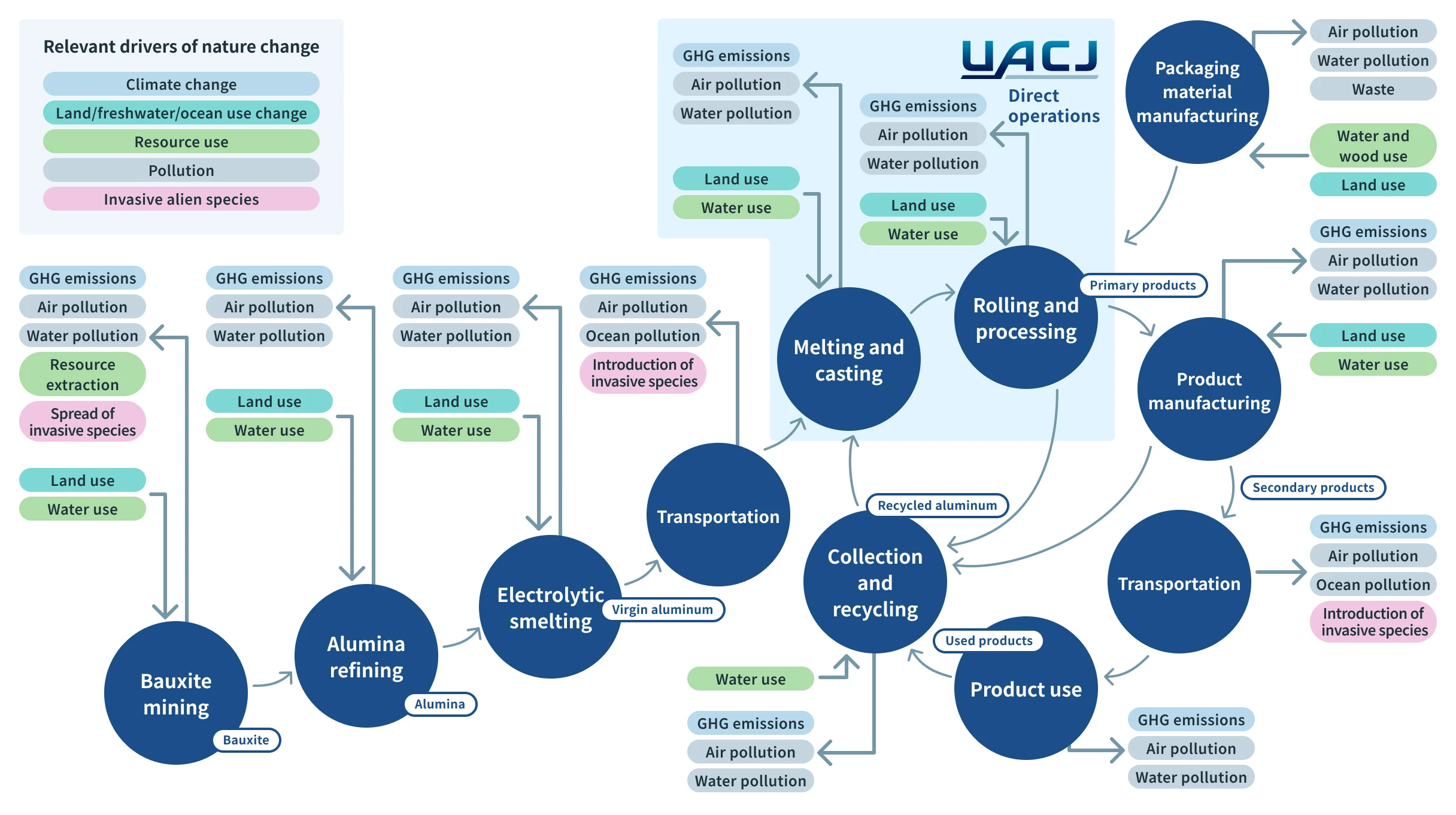
Interfaces with Nature in the UACJ Group Value Chain (Overview Diagram)
The following diagram outlines our analysis of the interfaces between the UACJ Group's value chain and nature.
It summarizes our nature-related impacts (e.g., GHG emissions, air and water pollution) and dependencies (e.g., land and water use) from bauxite mining to recovery and recycling.
Nature-related Risks and Opportunities for the UACJ Group
Based on our analysis of nature-related dependencies and impacts across the entire value chain, we have assessed the nature-related risks and opportunities for the UACJ Group. The results are detailed below.
These risks and opportunities were evaluated in line with the risk categories defined by the TNFD. Furthermore, we will consider conducting and disclosing the scenario analysis recommended by the TNFD in the future.
Nature-Related Risks in the UACJ Group
| Risk Categories | Nature-Related Risks | Financial Impacts | |
|---|---|---|---|
| Physical Risks |
Acute and Chronic risks | Water scarcity at supplier sites (bauxite mining and alumina refining companies) | Production halts and increased procurement costs due to supply chain disruptions |
| Water pollution and waste leakage, such as red mud, at supplier sites (bauxite mining and alumina refining companies) | |||
| Increase in natural disasters at supplier sites | |||
| Water scarcity around our own business sites | Operational suspensions Increased response costs |
||
| Damage to our own business sites due to natural disasters (floods and landslides) | |||
| Transition Risks |
Policy | Stricter regulations on bauxite mine development and ecosystem restoration | Increased procurement costs due to rising ecosystem conservation and restoration costs |
| Stricter forest-related regulations | Increased procurement costs for packaging materials | ||
| Market | Growing preference for aluminum with low water and land footprints, in addition to low GHG emissions | Avoidance of purchasing aluminum products with high environmental footprints | |
| Reputation | Criticism of bauxite mining as a driver of deforestation and increased avoidance of its purchase | ||
| Decline in corporate image and ESG scores if biodiversity and nature conservation initiatives are perceived as insufficient | Avoidance of purchasing the company's products due to declining corporate image and ESG scores | ||
| Litigation | Occurrence of pollutant spills and environmental accidents at supplier and our own sites | Incurrence of liability for environmental accidents Production halts and increased procurement costs due to supply chain disruptions |
|
Nature-related Opportunities in the UACJ Group
| Opportunity Categories | Opportunities Considered to Affect the UACJ Group | Financial Impacts | |
|---|---|---|---|
| Corporate Performance | Markets | Market preference for the high recyclability of aluminum | Increase in product sales |
| Resource Efficiency | Shift toward recycled materials and renewable energy | Reduction in manufacturing costs by promoting energy savings and circularity in manufacturing process | |
| Financial | Expanded financing opportunities through strengthened biodiversity and nature-related initiatives | Diversified options for resource procurement | |
| Products and Services | Development of products and services contributing to GHG emissions reduction and nature positive outcomes | Increased product sales from new markets | |
| Reputational Capital | Enhancing reputation and ESG ratings through strengthened biodiversity and nature-related initiatives | Increase in product sales driven by enhanced reputation | |
| Establishing the image of aluminum as a low-environmental-impact material by highlighting its recyclability. | |||
| Strengthened relationships with local communities and municipalities through the conservation of ecosystems and biodiversity at and around our business sites | |||
| Sustainability Performance | Sustainable use of natural resources | Reduction of environmental impacts from new land conversion by promoting the use of recycled materials | — |
| Protection, Restoration, and Regeneration of Ecosystem | Contribution to forest conservation and groundwater recharge in the watersheds where our business sites are located | — | |
2. Analysis of Nature-Related Issues at Manufacturing Sites and Identification of Priority Locations
Location-Specific Analysis of Nature-Related Issues in Direct Operations
We conducted an analysis of 49 major manufacturing sites using location data to identify and assess region-specific nature-related issues by understanding the characteristics of the natural environment and nature-related risks in the areas where the UACJ Group's manufacturing sites are located.
The 49 principal UACJ Group locations included in the scope of analysis
| no. | Company Name | Site Name | Country | Region Name |
|---|---|---|---|---|
| 1 | Tri-Arrows Aluminum Inc./UACJ North America, Inc. | USA | Kentucky | |
| 2 | Logan Aluminum Inc. | USA | Kentucky | |
| 3 | UACJ Metal Components North America, Inc. | USA | Pennsylvania | |
| 4 | UACJ Trading&Processing America, Inc. | USA | Michigan | |
| 5 | UACJ Automotive Whitehall Industries, Inc. | Head Office Michigan District Plant | USA | Michigan |
| 6 | UACJ Automotive Whitehall Industries | Paducah Plant | USA | Kentucky |
| 7 | UACJ Automotive Whitehall Industries | Flagstaff Plant | USA | Arizona |
| 8 | UACJ Automotive Whitehall Industries | Sanmiguel Plant | Mexico | Guanajuato |
| 9 | UACJ Metal Components Central Mexico, S.A. de C.V. | Mexico | Guanajuato | |
| 10 | UACJ Metal Components Mexico, S.A. de C.V. | Mexico | Baja California | |
| 11 | UACJ Extrusion Czech s.r.o. | Czech Republic | Central Bohemia Region | |
| 12 | UACJ ELVAL HEAT EXCHANGER MATERIALS GmbH | Germany | Dusseldorf | |
| 13 | Boyne Smelters Ltd. | Australia | Boyne Island | |
| 14 | UACJ (Thailand) Co., Ltd. | Thailand | Rayong Province | |
| 15 | UACJ Extrusion (Thailand) Co., Ltd. | Thailand | Prachinburi Province | |
| 16 | UACJ Metal Components (Thailand) Co., Ltd. | Thailand | Pathum Thani Province | |
| 17 | RUYUAN DONGYANGGUANG UACJ FINE ALUMINUM FOIL CO., LTD. | China | Guangdong Province | |
| 18 | Dicastal UACJ Bolv (Tianjin) Extrusion Corporation | China | Tianjin City | |
| 19 | DICASTAL UACJ BOLV AUTOMOTIVE COMPONENTS CO., LTD. | China | Qinhuangdao City | |
| 20 | DICASTAL UACJ BOLV (CHUZHOU) AUTOMOTIVE COMPONENTS CO., LTD. | China | Chuzhou City | |
| 21 | UPIA Co., Ltd. | Korea | Asan City, South Korea | |
| 22 | PT. YANJIN INDONESIA | Indonesia | Bekasi Regency | |
| 23 | UACJ Foundry & Forging (Vietnam) Co.,Ltd. | Vietnam | Ho Chi Minh City | |
| 24 | UACJ Foil Malaysia Sdn. Bhd. | Malaysia | Johor State | |
| 25 | Fukaya Works | Japan | Saitama Prefecture | |
| 26 | Nagoya Works (Flat Rolled), Nagoya Works (Extrusion) | Japan | Aichi Prefecture | |
| 27 | Oyama Works | Japan | Tochigi Prefecture | |
| 28 | UACJ Extrusion Gunma Corporation | Japan | Gunma Prefecture | |
| 29 | Site of the former Nikko Works | Japan | Tochigi Prefecture | |
| 30 | Fukui Works | Japan | Fukui Prefecture | |
| 31 | UACJ Extrusion Anjo Corporation | Japan | Aichi Prefecture | |
| 32 | UACJ Extrusion Shiga Corporation | Japan | Shiga Prefecture | |
| 33 | Light Metals Extrusion Development Co., Ltd. | Japan | Mie Prefecture | |
| 34 | Nihon Cooler Co., Ltd. | Japan | Hyogo Prefecture | |
| 35 | UACJ Metal Components Corporation | Hiroshima Works | Japan | Hiroshima Prefecture |
| 36 | UACJ Metal Components Corporation | Shiga Works | Japan | Shiga Prefecture |
| 37 | UACJ Metal Components Corporation | Koriyama Works | Japan | Fukushima Prefecture |
| 38 | UACJ Metal Components Corporation | Narita Works | Japan | Chiba Prefecture |
| 39 | UACJ Metal Components Corporation | Sendai Works | Japan | Miyagi Prefecture |
| 40 | UACJ Metal Components Corporation | Ena Works | Japan | Gifu Prefecture |
| 41 | Nikkin Co., Ltd. | Saitama Plant | Japan | Saitama Prefecture |
| 42 | UACJ Foil Corporation | Nogi Works | Japan | Tochigi Prefecture |
| 43 | UACJ Foil Corporation | Shiga Works | Japan | Shiga Prefecture |
| 44 | Foundry & Forging Works | Japan | Tochigi Prefecture | |
| 45 | UACJ Aluminum Center Corporation | Nara Works | Japan | Nara Prefecture |
| 46 | KAMAKURA INDUSTRY COMPANY LIMITED | Japan | Shizuoka Prefecture | |
| 47 | UACJ Aluminum Center Corporation | Utsunomiya Works | Japan | Tochigi Prefecture |
| 48 | UACJ Marketing & Processing Corporation | Japan | Aichi Prefecture | |
| 49 | UACJ Aluminum Center Corporation | Shiga Works | Japan | Shiga Prefecture |
Analysis Methodology
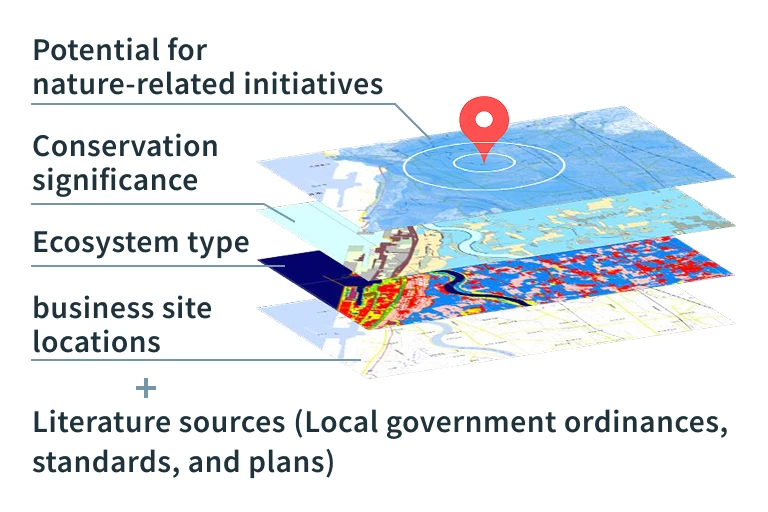
1. Organization of Location Information
We compiled the following basic information regarding the areas surrounding our business sites.
| Assessment Locations | Data | Source |
|---|---|---|
| Overseas sites | Base map (broad / detailed) | Esri Base Map |
| Satellite imagery (broad / detailed) | MAXAR Satellite Data | |
| Domestic sites | Base map (broad / detailed) | Geospatial Information Authority of Japan (GSI) |
| Satellite imagery (broad / detailed) | MAXAR Satellite Data | |
| Location within the catchment | National Land Numerical Information: Catchment boundaries and non-catchment areas | |
| Land use map | JAXA High-Resolution Land Use/Land Cover Map ver. 23.12 | |
| Degree of vegetation naturalness | Ministry of the Environment Vegetation Map | |
| Positional relationship with protected areas (broad / detailed) | National Land Numerical Information: National forests, natural park areas, nature conservation areas, and wildlife protection areas | |
| Expected rainwater infiltration capacity | Ministry of the Environment EADAS: Expected rainwater infiltration capacity based on topography, geology, etc. | |
| Estimated flood inundation area | National Land Numerical Information: Estimated flood inundation area data (by river), Estimated tsunami inundation data |
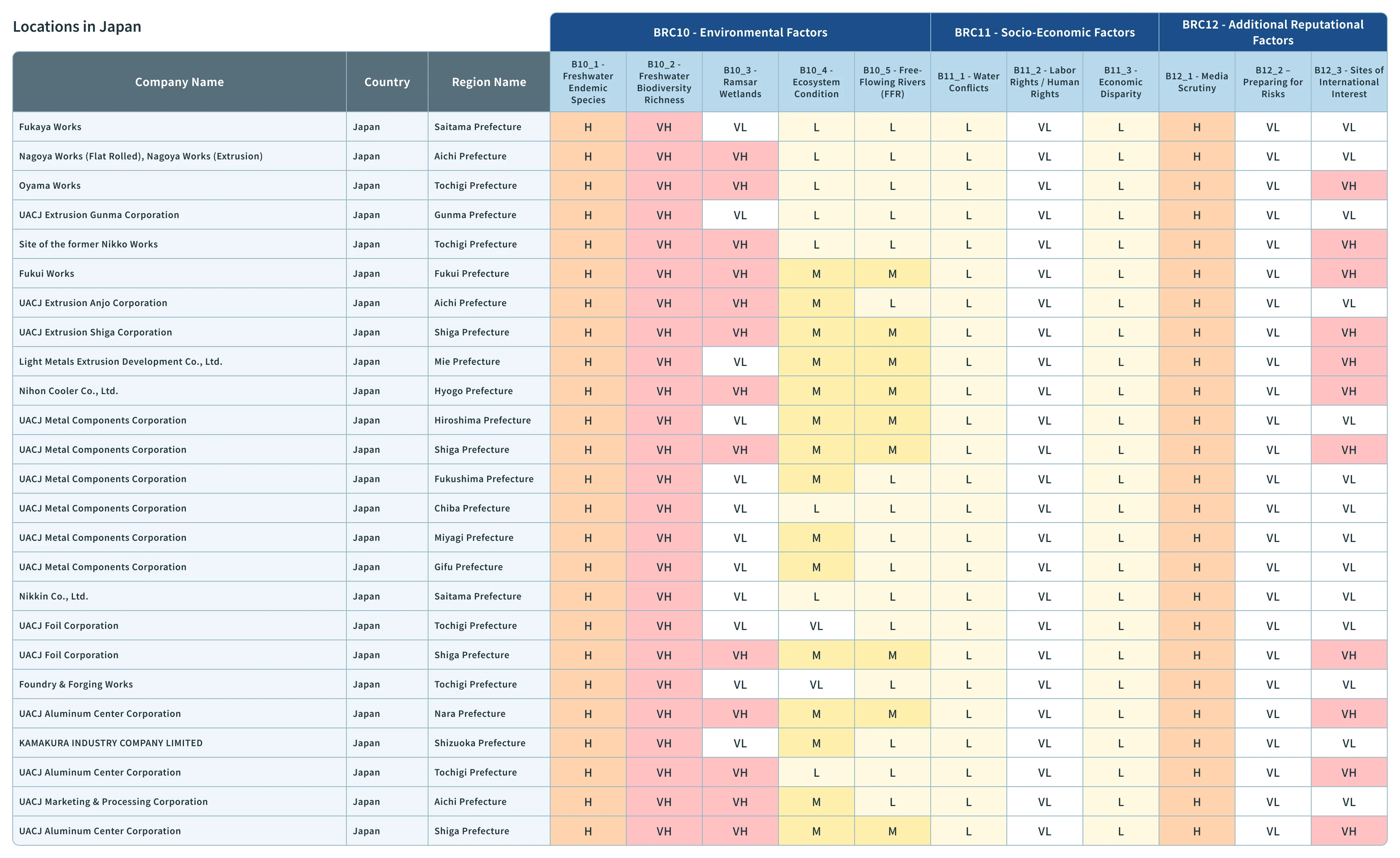
For the 49 target locations, we confirmed local site conditions using spatial and literature data regarding the surrounding natural environment. By analyzing these site-specific characteristics, we inferred their unique interfaces with nature, determined the strategic direction and anticipated impact of our initiatives, and identified priority locations for action.
Visualization of the analysis method
Examples of Site Analysis
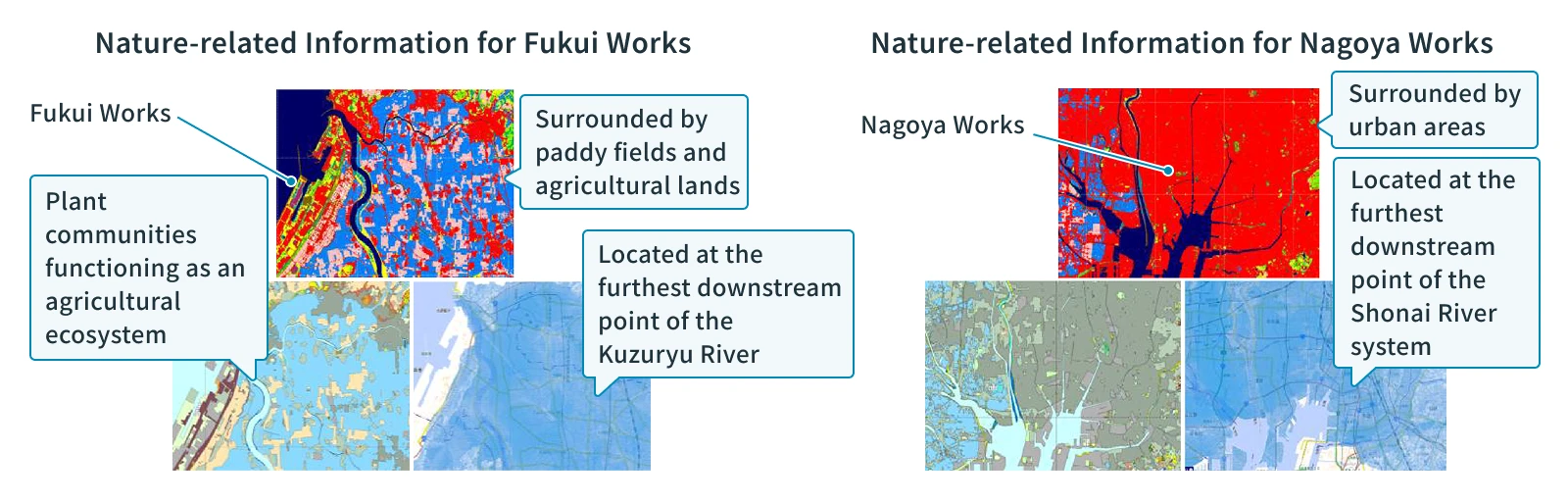
- Key findings are summarized in the table below.
2. Identification of Water and Biodiversity-Related Risks
We assessed site-specific water and biodiversity-related risks using the WWF Water Risk Filter Suite v2.0 (comprising the WWF Water Risk Filter and WWF Biodiversity Risk Filter).
Water Risk Analysis using the WWF Water Risk Filter (2024)
We conducted a high-level catchment-level water risk screening across our business sites using the WWF Water Risk Filter, an online platform that enables companies and financial institutions to evaluate biodiversity and water related risks.
The water risks covered by the WWF Water Risk Filter consist of physical, regulatory, and reputation risks.
Reference: Mapping of the Comprehensive Evaluation of Physical Risks in River Basins
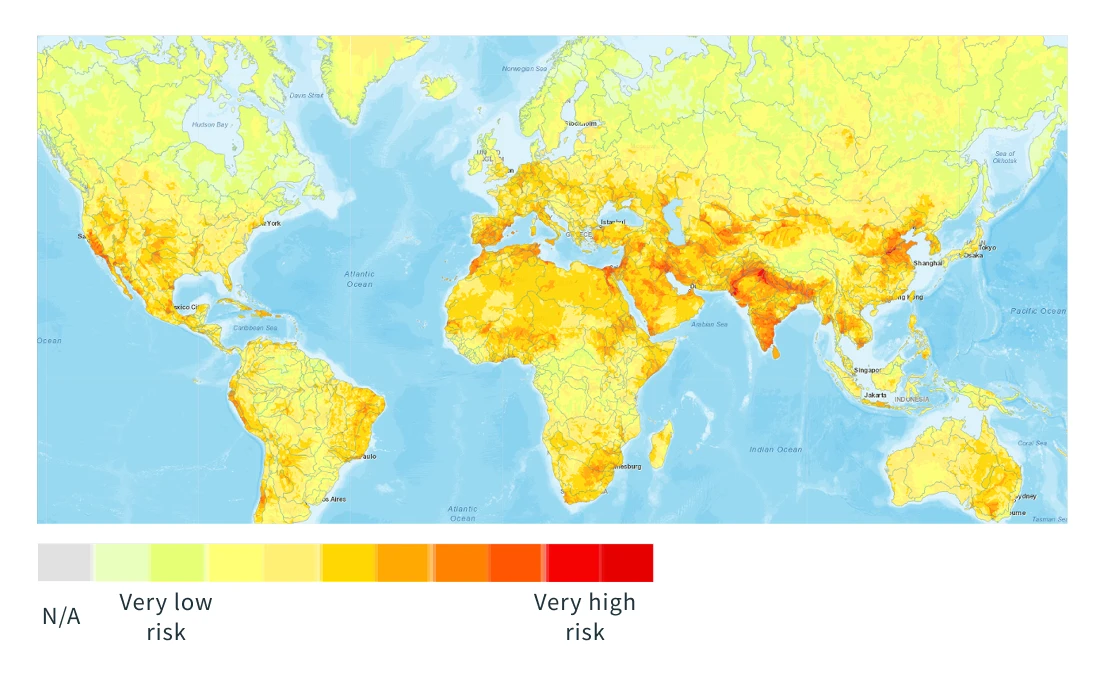
- Source: WWF
Physical Risks
Physical risks represent the conditions of both natural and human-induced factors within river basins. The risk categories are:
1) Water availability
2) Drought
3) Flooding
4) Water quality
5) Ecosystem services condition
Regulatory Risks
Regulatory risks relate to the concepts of good governance and the corporate regulatory environment. The risk categories are:
6) Enabling environment (primarily related to laws and policies)
7) Institutions and governance
8) Management instruments
9) Water and sanitation infrastructure
Reference: Mapping of the Comprehensive Evaluation of Reputation Risks in River Basins
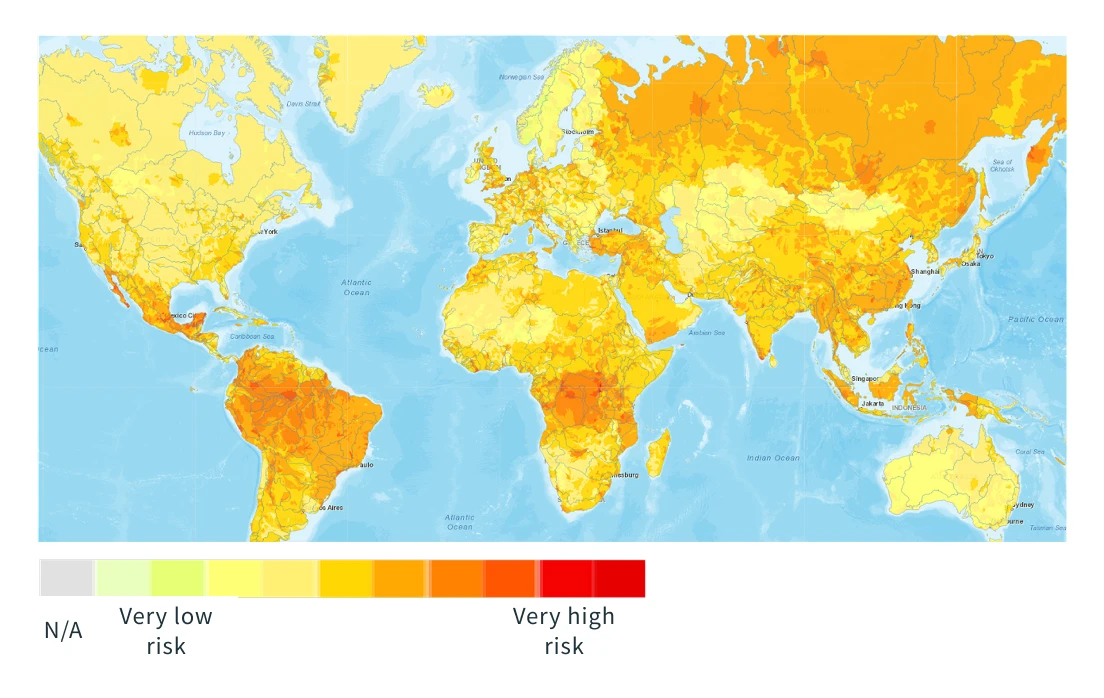
- Source: WWF
Reputation Risks
While much of reputational risk ultimately translates into business risk, catchment-specific conditions significantly heighten the likelihood of these risks materializing. Reputation risk reflects the perceptions of stakeholders and local communities regarding whether a company engages with water resources through sustainable and responsible business activities. The risk categories are:
10) Environmental factors
11) Socioeconomic factors
12) Other reputational factors
An evaluation of the risk scores for the river basins across UACJ Group's sites identified locations with high scores for physical and reputation risks. The details of our analysis regarding these high-scoring locations are disclosed in sections (1) and (2) below.
(1) Four Business Sites Rated "High" for Overall Basin Physical Risk in the WWF Water Risk Filter and Breakdown by Risk Type
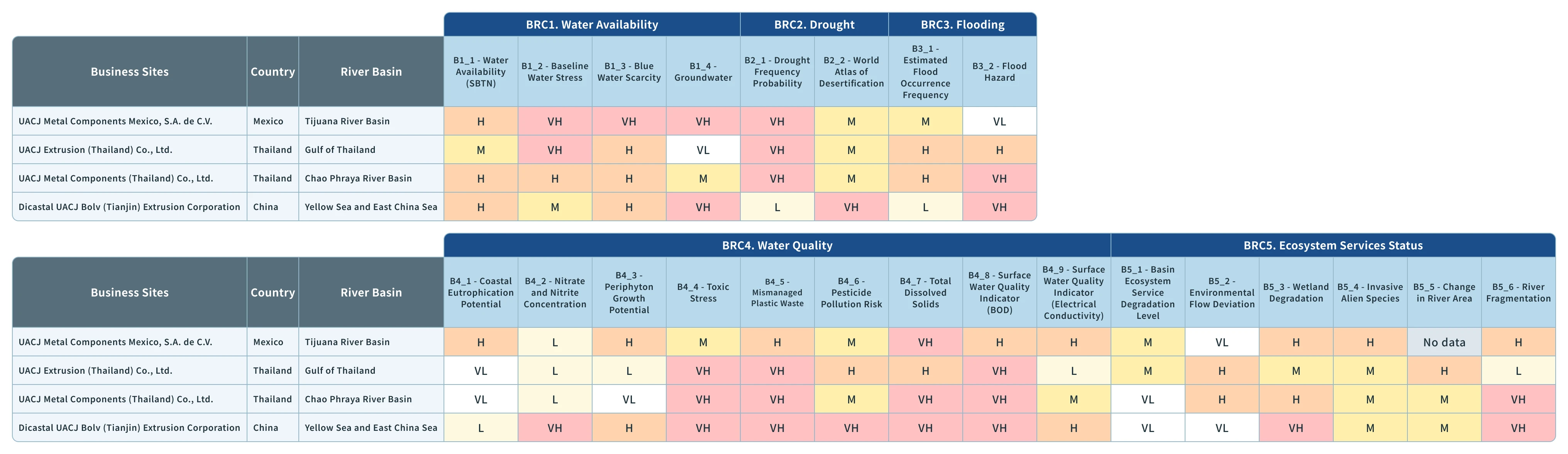
| River Basin | Site Name | Physical Water Risks |
|---|---|---|
| Tijuana River Basin | UACJ Metal Components Mexico, S.A. de C.V. |
Due to extremely high water stress, there are substantial risks to water security, including the threat of droughts. Water pollution caused by pesticides and other chemicals, along with the reduction in the extent of wetlands and rivers, is highly likely to negatively impact ecosystem services. It is imperative to ensure that business activities do not cause adverse impacts on water resources and the environment. |
| Gulf of Thailand | UACJ Extrusion(Thailand) |
This region experiences high water stress and faces significant risks of droughts and floods. Furthermore, there are growing concerns regarding the deterioration of water quality. Close attention must be paid to prevent overexploitation and wastewater discharge from placing additional stress on water resources and water quality. |
| Chao Phraya River Basin |
UACJ Metal Components (Thailand) |
The basin faces high risks of droughts and floods, along with growing concerns over water quality degradation driven by chemical pollution. Furthermore, poor scores regarding river fragmentation indicate that the local ecosystems are currently in a degraded state. It is imperative to implement strategic initiatives that avoid further ecosystem degradation caused by business activities. |
| Yellow Sea and East China Sea | Dicastal UACJ Bolv (Tianjin) Extrusion Corporation |
The region faces high water stress, with groundwater being particularly heavily stressed. It also carries high risks of desertification and flooding, while water quality degradation caused by chemical substances is a concern across multiple indicators. In addition, the region receives unfavorable scores for wetland degradation and river fragmentation. During operations, it is imperative to ensure that excessive water withdrawal and wastewater discharge do not exert additional pressure on water resources and water quality. |
(2) As the WWF Water Risk Filter classified basin reputational risk as "Very High" for certain items across all assessed sites, we disclose the details by risk type for every location.
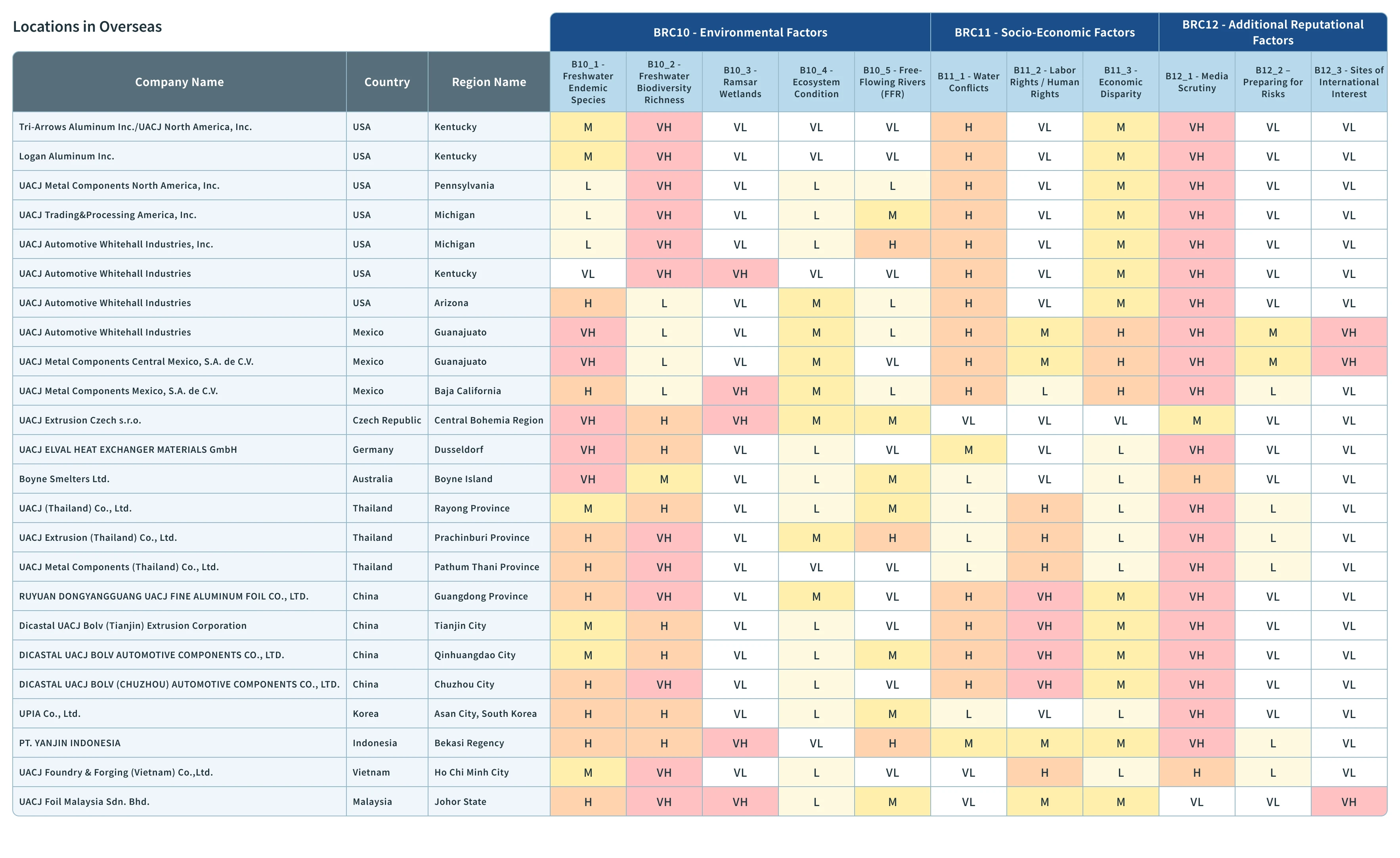
| Region | Water Risk (Reputational Risk) |
|---|---|
| North America | Reputational risk is high in the U.S. due to freshwater biodiversity, and in Mexico due to the importance of endemic freshwater species. In both the U.S. and Mexico, historical conflicts over water have occurred between companies and catchment stakeholders, leading to high media scrutiny risks. |
| Europe | Reputational risk stemming from the importance of endemic freshwater species is generally high, and the significance of media scrutiny risk is notably high in Germany. |
| Region | Water Risk (Reputational Risk) |
|---|---|
| Oceania | There is a high importance of reputational risk due to endemic freshwater species and media scrutiny risk. |
| Asia | There is a high risk in Southeast Asia due to rich freshwater biodiversity. In China, socioeconomic reputational risks arising from the status of human rights and media scrutiny risks are generally high. Japan faces a generally high reputation risk, primarily driven by its rich freshwater biodiversity with a high rate of endemic species, the presence of numerous Ramsar wetlands, and its overall status as a region attracting significant international attention. |
3. Assessment of Proximity to Protected Areas and Red List Species
Using the Integrated Biodiversity Assessment Tool (IBAT), we evaluated the following metrics for each business site:
- Protected Areas within a 50 km radius
- Red List species present
- Threatened species present
- Key Biodiversity Areas (KBAs) within a 50 km radius
The analysis results for each operating location, evaluated using additional metrics, are summarized below.
| Location | Risk Profile | IBAT | WWF Water Risk Filter |
WWF Biodiversity Risk Filter |
Spatial Data |
|---|---|---|---|---|---|
| North America | Mexico faces high water risks driven by water quality. Both the U.S. and Mexico exhibit high reputation risks, including conflicts and media scrutiny. |
The number of threatened species inhabiting the vicinity and the proximity to Key Biodiversity Areas (KBAs) are lower compared to other regions. | Please refer to the aforementioned Water Risk Filter analyses. | Regarding physical risks, the impacts on biodiversity caused by land, freshwater, and ocean use change are significant. Risks stemming from forest loss and pollution are also high. | Many sites are located in rural areas or industrial zones within peri-urban areas. |
| In terms of reputation risks, the specific risk associated with media scrutiny is high. | |||||
| Europe | Germany has a wide distribution of protected areas, resulting in a high reputation risk due to potential impacts on these protected areas. (Regulatory risks are also anticipated in the future.) Furthermore, both business sites face high risks stemming from pollution. |
There is a significant number of protected areas and Key Biodiversity Areas (KBAs) in close proximity to the sites. A high concentration of protected areas is located in the vicinity of our sites in Germany. | Regarding physical risks, Germany is highly exposed to risks driven by land, freshwater, and ocean use change, as well as pollution. The Czech Republic faces high impact risks associated with forest loss and pollution. | The site in Germany is situated on the floodplain of a meandering river. | |
| In terms of reputational risks, the Czech Republic presents a lower risk compared to other countries, whereas Germany faces high risks driven by media scrutiny and the widespread distribution of protected areas. | The site in the Czech Republic is located in a rural area. | ||||
| Oceania | The region is home to a large number of threatened species, facing in a high reputation risk driven by media scrutiny. | A large number of endangered species inhabit the vicinity of our business sites. | There is a high physical risk associated with tree cover loss. | In addition to media scrutiny, there is a high reputation risk concerning potential impacts on protected areas. | |
| For reputation risk, impacts on protected areas pose a highly significant threat, alongside the risks associated with media scrutiny. | |||||
| Asia | Our business sites in Thailand and China face high physical risks driven by water supply and natural disasters. Southeast Asia serves as a habitat for a significantly large number of threatened species. Furthermore, Japan faces reputation risk due to the critical importance and high profile of biodiversity in the country. |
Sites in Indonesia, Vietnam, and Malaysia are characterized by an exceptionally high number of threatened species inhabiting the surrounding areas compared to other regions. Sites in Japan feature the second-highest number of nearby protected areas after Europe, as well as a significant number of Key Biodiversity Areas (KBAs). |
Regarding physical risk, there are risks originating from water supply in the Chao Phraya River basin in Thailand and the Yellow Sea and East China Sea regions in China, risks associated with forest loss in Vietnam and Malaysia, and pollution-related risks across Asia, including Japan. | A large number of our sites are situated within industrial agglomeration zones. Certain sites in Thailand, China, Vietnam, and Malaysia are located adjacent to rivers. | |
| Regarding reputation risks, in addition to the risk of media scrutiny, Thailand and Japan face high risks of impacting adjacent protected areas, while China presents high human rights risks. |
Our assessment of nature-related issues across the regions of our direct operations has enabled us to identify the natural characteristics, water risks, and biodiversity risks specific to each location.
Recognizing that these findings currently provide only a regional overview, our next step is to conduct site-specific evaluations and formulate targeted responses. Building on these efforts, we will develop the UACJ Group's strategy to actively manage risks and create opportunities.
3. Setting the UACJ Group's Strategy and Targets
Selection of Priority Locations
The TNFD recommendations require organizations to identify and disclose priority locations where they should prioritize their actions.
For direct operations in Japan, the UACJ Group has selected priority locations for specific activities based on the results of location-specific analyses. The TNFD defines priority locations as "material locations" and "sensitive locations". Aligning with the TNFD's "material locations," we initially targeted areas where risks arising from dependencies on local ecosystem services are anticipated. Furthermore, to address "sensitive locations," we selected areas characterized by abundant surrounding nature and significant impacts on biodiversity.
In the selection process, we considered in data on the natural environment surrounding our manufacturing facilities, drawing upon the assessment results across the entire value chain and the location-specific analysis of our direct operations.
Selected Priority Locations
| Type | Selected sites |
|---|---|
|
|
|
|
Action plan
The UACJ Group's Actions toward Realizing Nature Positive
The UACJ Group has continuously worked to address biodiversity-related issues. In fiscal 2023, we added "Supporting Environmental Health and Nature (Nature Positive)" as a sustainability-related materiality issue, and have been implementing concrete measures by establishing a roadmap toward realizing Nature Positive. This roadmap includes preparations for information disclosure in line with the TNFD recommendations, which involved analyzing and assessing nature-related issues.
This fiscal year, based on the results of our analysis of nature-related issues in accordance with the TNFD recommendations, we have formulated an action plan that outlines the specific initiatives that the UACJ Group must take to achieve Nature Positive.
Risk and Impact Management
Within the UACJ Group, the Nature Positive Working Group operating under the Environment Committee, leads the management of nature-related issues in close collaboration with relevant business divisions.
The Executive Committee, an advisory body to the President, deliberates and receives reports on nature-related risks that could result in material financial effects. Through this process, the Committee makes definitive decisions to drive risk management and closely monitors the PDCA cycle.
Metrics and Targets
Core Global Disclosure Metrics
The UACJ Group's FY2025 performance corresponding to the core global disclosure metrics is as follows.
The reporting boundary for the FY2025 performance encompasses a total of 13 facilities: UACJ (Nagoya, Fukui, and Fukaya), UACJ Aluminum Center (Utsunomiya Color Aluminum), UACJ Extrusion Nagoya (Nagoya and Anjo), UACJ Extrusion Oyama, UACJ Extrusion Gunma, UACJ Extrusion Shiga, UACJ Foil (Isesaki, Shiga, and Nogi), and UACJ Foundry & Forging.
Core Global Disclosure Metrics (FY2025 performance)
| Metric No. | Drivers of Nature Change | Indicator | Metric | FY2025 performance | ||||
|---|---|---|---|---|---|---|---|---|
| C2.1 | Pollution / Pollution Removal | Wastewater discharged | Total volume of water discharged by destination | Fresh surface water | 6,656 | thousand tons | ||
| Seawater | 273 | thousand tons | ||||||
| Third-party water (sewers, etc.) | 1,505 | thousand tons | ||||||
| Wastewater quality (Target facilities: UACJ (Nagoya, Fukui, Fukaya)) | pH, BOD, n-H, SS | Below the standard limit | ||||||
| C2.2 | Waste generation and disposal | Total amount of waste generated | Hazardous waste | Direct landfill disposal amount | 2,985 | t | ||
| Industrial waste | 5,833 | t | ||||||
| Recycled materials | 949 | t | ||||||
| Non-hazardous waste | Direct landfill disposal amount | 4,025 | t | |||||
| Industrial waste | 3,285 | t | ||||||
| Recycled materials | 16,268 | t | ||||||
| C2.4 | Total volume of non-GHG air pollutants | Air pollutant emissions | SOx | 64 | t | |||
| NOx | 502 | t | ||||||
| C3.1 | Resource Use / Replenishment | Water withdrawal and consumption from areas of water scarcity | Water withdrawal by source | Groundwater | 2,877 | thousand tons | ||
| Third-party water (industrial water, etc.) | 7,367 | thousand tons | ||||||
2030 Materiality Targets
As its FY2030 target, the UACJ Group aims to reduce water withdrawal by at least 25% to advance the "Supporting Environmental Health and Nature (Nature Positive)," one of our key sustainability-related materiality issues.
Going forward, we will formulate target values for our other activities, we will monitor and disclose our progress against the aforementioned action plans.
Specific Initiatives of the UACJ Group
The UACJ Group has consistently implemented diverse initiatives that contribute to nature-positive outcomes. These sections detail our activities and achievements.
- 1. Group-wide initiatives to reduce water withdrawal
- 2. Identifying Risks to Biodiversity
- 3. Making Packing Materials Recyclable
- 4. Helping to Eliminate Invasive Species
- 5. Greening Activities
- 6. "The UACJ Fukui Forest" UACJ signed a corporate forestation agreement with Fukui Prefecture and Sakai City. Promoting local environmental conservation through tree planting and other forest conservation activities
- 7. Leading a Circular Economy in Aluminum
- 8. Taking Measures to Address Climate Change