


Human Resource Development and Fair Treatment
 Share
ShareOur Approach
We believe that cultivating individuals with the ability to make proactive decisions and take the lead in solving problems following the UACJ Way is essential for the Group’s future development in the evolving business environment. The objective of our human resource development initiatives is for each employee to grow individually and feel fulfillment in their careers.
We established "Monozukuri Academy" (manufacturing academy) in fiscal 2025 to continuously implement personnel development Group-wide.
"Monozukuri Academy" adopts three core principles: "growth through individual employee learning," "developing subordinates through on-the-job experience," and "developing talent as an organization." It promotes development centered on three pillars: "rank-specific training," "specialized training," and "common training" such as in seminars and self-development programs.
Human Resource Development Program
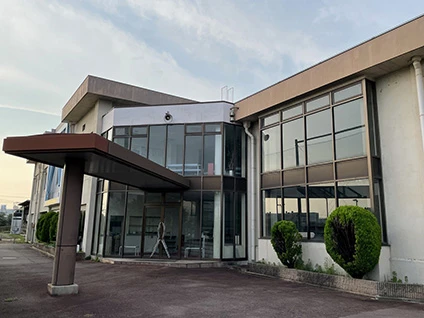
The UACJ Group offers various training programs, such as training and seminars for specific job positions using the facilities at the Human Resources Development Center at the Nagoya Works. We are also developing online programs to facilitate participation even from off-site locations. In fiscal 2024, a total of 2,497 members participated in 72 employee training sessions held over 205 days.
Per-Employee Training Data (Fiscal 2025)
- Avg. time spent in training: About4.4hours
- Avg. cost of training: About23,000yen
Job-Level Training
The purpose of job-level training is for employees to sharpen awareness of their job-level roles, acquire the professional capabilities and knowledge required to fulfill their job responsibilities, and deepen their understanding of the company’s aims and systems.
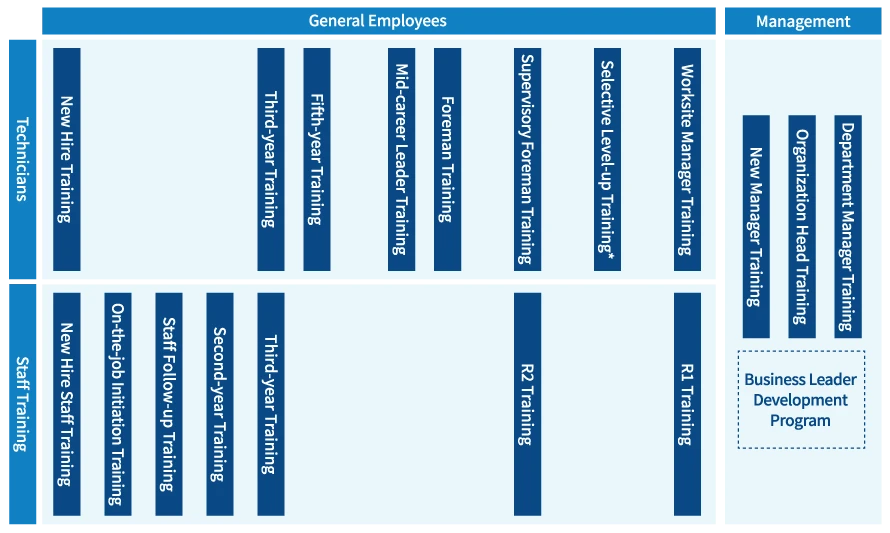
For staff employees, we conduct a series of training programs over the first three years of employment. For employees in their fourth year after joining the company and employees up through section manager level, we provide ongoing training geared to senior staff, management, new manager, organizational head and other job levels. We also conduct the Business Leader Development Program to prepare people for top management positions in the future.
For employees in skilled labor departments, we conduct training programs at the time of hiring and in the third and fifth years of employment. From the sixth year of service, employees participate in training as required for their job level.
- For supervisory foreman
Fiscal 2025 Job-Level Training Participation
(Individuals)
| UACJ | Affiliates | Total | |
|---|---|---|---|
| Management | 171 | 131 | 302 |
| Staff | 376 | 101 | 477 |
| Skilled Labor | 294 | 184 | 478 |
| Total | 841 | 416 | 1,257 |
Common courses aimed at individual skill enhancement and knowledge acquisition
In addition to hierarchical training, the UACJ Group is expanding the scope of common Group-wide courses with the primary aim of acquiring knowledge that should be shared across the Group, enhancing individual skills and specialized expertise, and ensuring the acquisition of knowledge essential to targeted workplaces. Specifically, we have arranged courses led by experienced in-house instructors. These include established programs—such as instructor training for mid-level employees, on-the-job training (OJT) guidance for new hires, quality control (QC), naze naze analysis*1, autonomous maintenance, and PowerPoint skills. We have also prepared sustainability- and compliance-related courses taught by experienced internal instructors. In addition, we conduct seminars for accounting and corporate finance aimed at improving business skills.
- Naze naze (why why) analysis is a problem-solving approach that focuses on ascertaining fundamental causes.
Support for Self-Development
We offer correspondence courses, support for acquiring official certifications, and language education to support the needs of individual employees and the work sites. In addition, as support for skill enhancement outside of in-house training and seminars, we also conduct personnel development through dispatch to external organizations.
Developing Human Resources for Overseas Roles
To develop global talent, we have dispatched a total of nine individuals to date to overseas Group companies through our overseas trainee program (one year of overseas language training + 1.5 years as a trainee). In fiscal 2025, we are revising the overseas trainee program to build and strengthen a framework capable of developing a greater number of global talent.
Improving Frontline Capabilities (Handing down technical skills)
Efforts to pass on the monozukuri (manufacturing) spirit, experience, and skills veteran employees have developed and acquired over their long careers are critical for maintaining product quality and continuously improving productivity.
In preparation for the coming increase in veteran technicians reaching the mandatory retirement age, the UACJ Group’s Nagoya Works began a program in 2004 to transfer the skills, instinct, and “tricks of the trade” - the professional know-how – of veteran employees to their younger colleagues. For the same purpose, we also opened a academy for maintenance skills at Nagoya Works and an academy for extrusion skills at Nagoya Works (at the division tasked with extrusion). We also opened academy for plate production skills at Fukui Works in fiscal 2017 and at Fukaya Works in fiscal 2023. In 2021, we also opened maintenance dojos at Fukui Works and Fukaya Works. Furthermore, in fiscal 2025, we will open an academy for extrusion skills at Oyama Works (at the division tasked with extrusion) and an academy for foundry and forging skills at our Foundry & Forging Works, and we will begin systematic initiatives for such academies at Group companies, with activities currently expanding.
Meanwhile, we are actively rehiring retirees with technical backgrounds and making the most of their capabilities to enhance the skills of their younger colleagues.
Improving the Capabilities of Non-Manufacturing Staff
In fiscal 2020, the UACJ Know how Innovation on the work process (U-KI) activities primarily for our staff in non-manufacturing U-KI aims to create energetic teams that continuously and simultaneously produce better results and promote the growth of people and organizations. Starting with honest communication, U-KI is an approach for bringing together knowledge and capabilities to foster a team culture with significant contributions by all members. The U-KI method is also being used in position-based training and is actively used at Group companies in Japan and overseas.
The results of support efforts as of the end of fiscal 2025 are reflected in the numbers below.
- Business locations: 11
- Departments: 73
- Participants: 2,480
Development of technical staff
To develop young production engineers, we invited a university professor emeritus to deliver a seminar on plastic working. Through this program, participants learn to approach challenges from the perspective of fundamental principles, broaden their field of view when solving problems, and acquire the foundational methods that sustain high technical capabilities.
Implementation of various face-to-face meetings
For all employees, we conduct "feedback sessions" to provide feedback on individual performance evaluations and future expectations, as well as "communication sessions" to discuss individual career development. Feedback sessions not only enhance understanding and acceptance of evaluations but also help employees recognize their own challenges and lead to future behavioral change. Communication sessions involve reflecting on past and current work while encouraging employees to think proactively about their future career development from a medium- to long-term perspective and engaging in candid discussions about the challenges and goals that they should tackle to achieve future growth and performance.
Employee Compensation
The UACJ Group properly compensates employees and makes no gender-based distinctions in base pay. Full-time employees are provided systems for life insurance, medical expenses, disability and illness guarantees, childcare leave, retirement allowance, and shareholding plan system. Non-regular employees (part-time, part-time workers, contract workers) are provided life insurance, medical expenses, childcare leave, and the shareholding plan system. Contract employees are eligible for the shareholding plan system only.
Practicing Talent Management
UACJ has set human resources, technology, and corporate culture as the key elements in creating the foundation for achieving our long-term management objective, UACJ VISION 2030. To fulfill our vision, we believe it is critically important to develop the human resources to lead the next generation and to strategically allocate personnel so each person will gain skills that can contribute anywhere in the Group without being restricted to divisions or locations.
With that perspective, we launched specific plans for human resource development and successor training in fiscal 2021. We extensively discussed the medium- to long-term growth strategies for each business and corporate division and the human resources that will be needed to implement the strategies. We also defined the specific human resources that will be needed for the management strategies and created plans to develop highly effective human resource development and successor training.
Toward strategic personnel allocation, we are advancing the construction and introduction of a talent management system that centrally manages skills and experience levels and that utilizes such for appropriate global placement and personnel development, and we have begun operations. Defining human resources matched to the management strategies and launching the talent management system has improved our ability to visualize the human resource needs (talents) that are currently lacking or will be required in the future.
Even in a rapidly changing business environment, we will continue fostering a sense of group unity as we improve management efficiency and strengthen the integration of our management and human resource strategies to maximize synergies.
Employee-Management Relationship
Relations with labor unions are harmonious and information on the condition of the Company is regularly shared in central and business-site labor-management conferences. In April 2016, labor-management committees were formed at UACJ and at individual business sites to engage in ongoing discussions of measures for improving work-life balance by shortening working hours.
In addition, when deemed necessary, labor-management review committees are established to discuss issues and specific topics. We also initiate communicate with the labor union and the affected employees as early as possible regarding human resources management actions that have a significant impact on employees, such as transfers and changes in position.
Basic Workforce Data
UACJ Workforce Data
| FY2023 | FY2024 | FY2025 | ||||
|---|---|---|---|---|---|---|
| Number of employees | 2,993 | (200) | 3,894 | (304) | 3,940 | (328) |
| Men | 2,694 | (180) | 3,473 | (276) | 3,489 | (299) |
| Percentage of men | 90.0% | 89.2% | 88.6% | |||
| Women | 299 | (20) | 421 | (28) | 451 | (29) |
| Percentage of women | 10.00% | 10.80% | 11.40% | |||
| Average age | 41 | 41 | 41 | |||
| Under 30 years old | 19.00% | 17.60% | 17.90% | |||
| 30 to 50 years old | 55.00% | 56.00% | 55.30% | |||
| Over 50 years old | 26.00% | 26.50% | 26.80% | |||
| Average length of service (years) | 16.3years | 15.7years | 15.5years | |||
| Number of new employees (excluding temporary transfers) | 190 | 194 | 288 | |||
| Men | 155 | 159 | 248 | |||
| Percentage of men | 81.6% | 82.0% | 86.1% | |||
| Women | 35 | 35 | 40 | |||
| Percentage of women | 18.4% | 18.0% | 13.9% | |||
| Number of employees that left the Company | 181 | 161 | 144 | |||
| Men | 164 | 148 | 134 | |||
| Percentage of men | 90.6% | 91.9% | 93.1% | |||
| Women | 17 | 13 | 10 | |||
| Percentage of women | 9.4% | 8.1% | 6.9% | |||
| Turnover rate | 6.0% | 4.1% | 3.7% | |||
| Of which, left for personal reasons | 3.7% | 2.5% | 3.1% | |||
- 1 Figures in parentheses are the numbers of temporary employees (not included in totals)
- 2 As of March 31 of each year
UACJ Group Workforce Data (consolidated)
| FY2023 | FY2024 | FY2025 | ||||
|---|---|---|---|---|---|---|
| Number of group employees | 10,460 | (807) | 10,203 | (812) | 10,310 | (838) |
| Men | 8,697 | (660) | 8,437 | (665) | 8,495 | (702) |
| Percentage of men | 83.1% | 82.7% | 82.4% | |||
| Women | 1,763 | (147) | 1,766 | (147) | 1,815 | (136) |
| Percentage of women | 16.9% | 17.3% | 17.6% | |||
| By region | ||||||
| Japan | 6,106 | (678) | 6,126 | (715) | 6,210 | (725) |
| Asia | 2,360 | (59) | 2,305 | (41) | 2,333 | (41) |
| North/South America | 1,870 | (69) | 1,649 | (5) | 1,523 | (31) |
| Europe and other | 124 | (1) | 120 | (1) | 117 | (1) |
- Figures in parentheses are the average numbers of temporary employees (not included in totals)