

Enhancing Human Capital
 Share
ShareOur Approach
To realize "a light and vibrant world in 100 years," we have formulated our well-being vision: "toward a healthy and harmonious society where everyone can feel happiness." We view "well-being" as a positive state where individuals feel fulfilled and happy in both body and mind ("Well"), which connects to the "Well" of families, those around them, communities, and society, and in turn, that "Well" returns to each individual—this is the "Well WAVE." This concept serves as the foundation for our human capital management process, where we define the relationship between well-being and corporate value as: "working" → "happiness" → "economic value / corporate value."
Our department tasked with human resources strategy will lead the implementation of measures outlined in the newly formulated human capital management framework. In collaboration with relevant departments, we will develop measures from the perspectives of "enhancing the well-being of each employee" and "strengthening human and organizational capabilities," establish a roadmap and responsible departments, and aim to begin implementation from the next fiscal year. At the same time, to promote understanding of our Group’s approach to human capital, we plan to conduct awareness activities using existing philosophy dialogue sessions and other platforms.
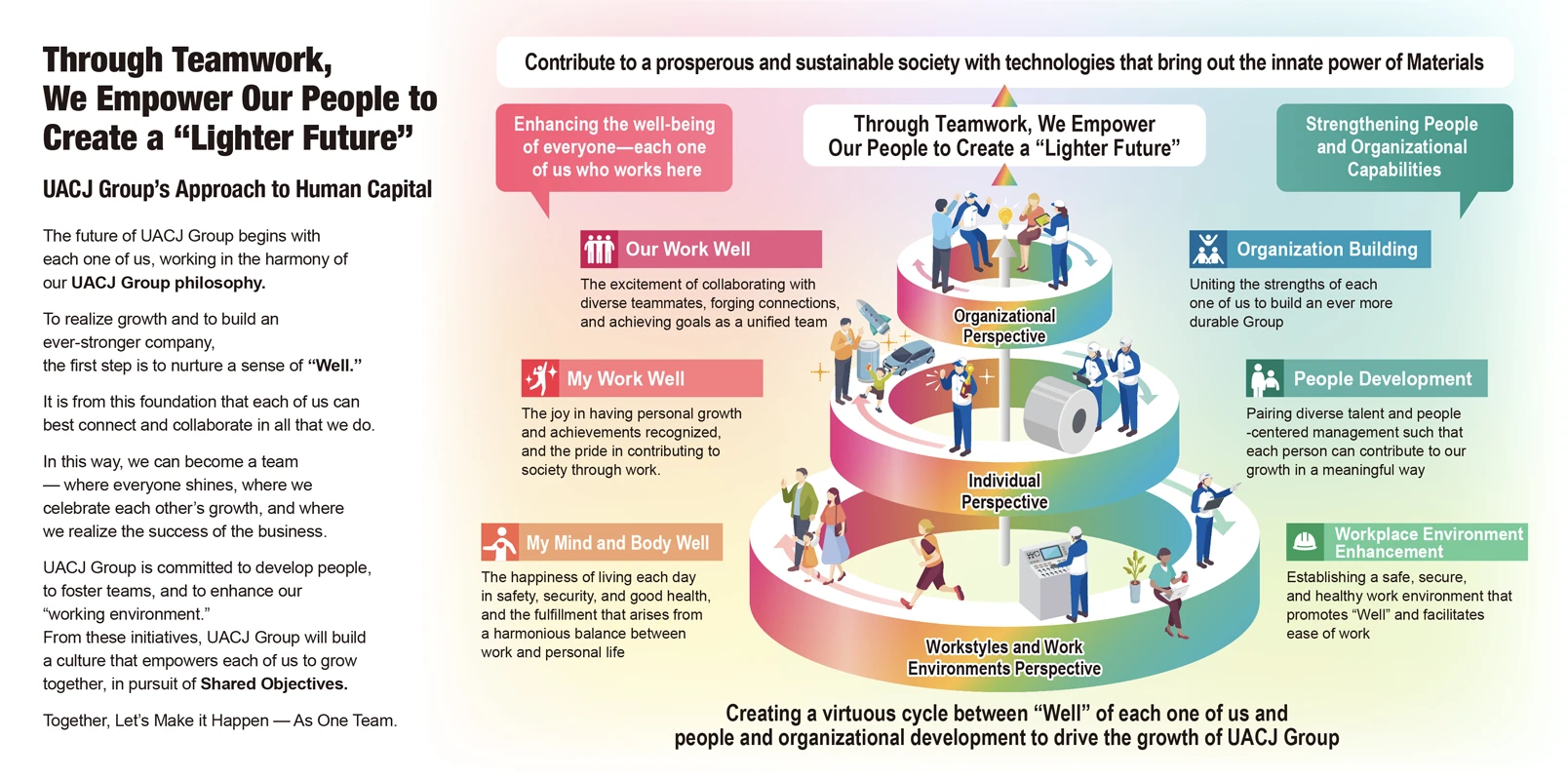
UACJ People Statement and an overview of human capital management
The newly formulated UACJ "People Statement," which articulates our Group’s approach to human capital, and our "overall framework for human capital management," which systematizes our human resources strategy, place emphasis on the well-being of each and every employee in the Group, in addition to our conventional human resources strategy perspectives.
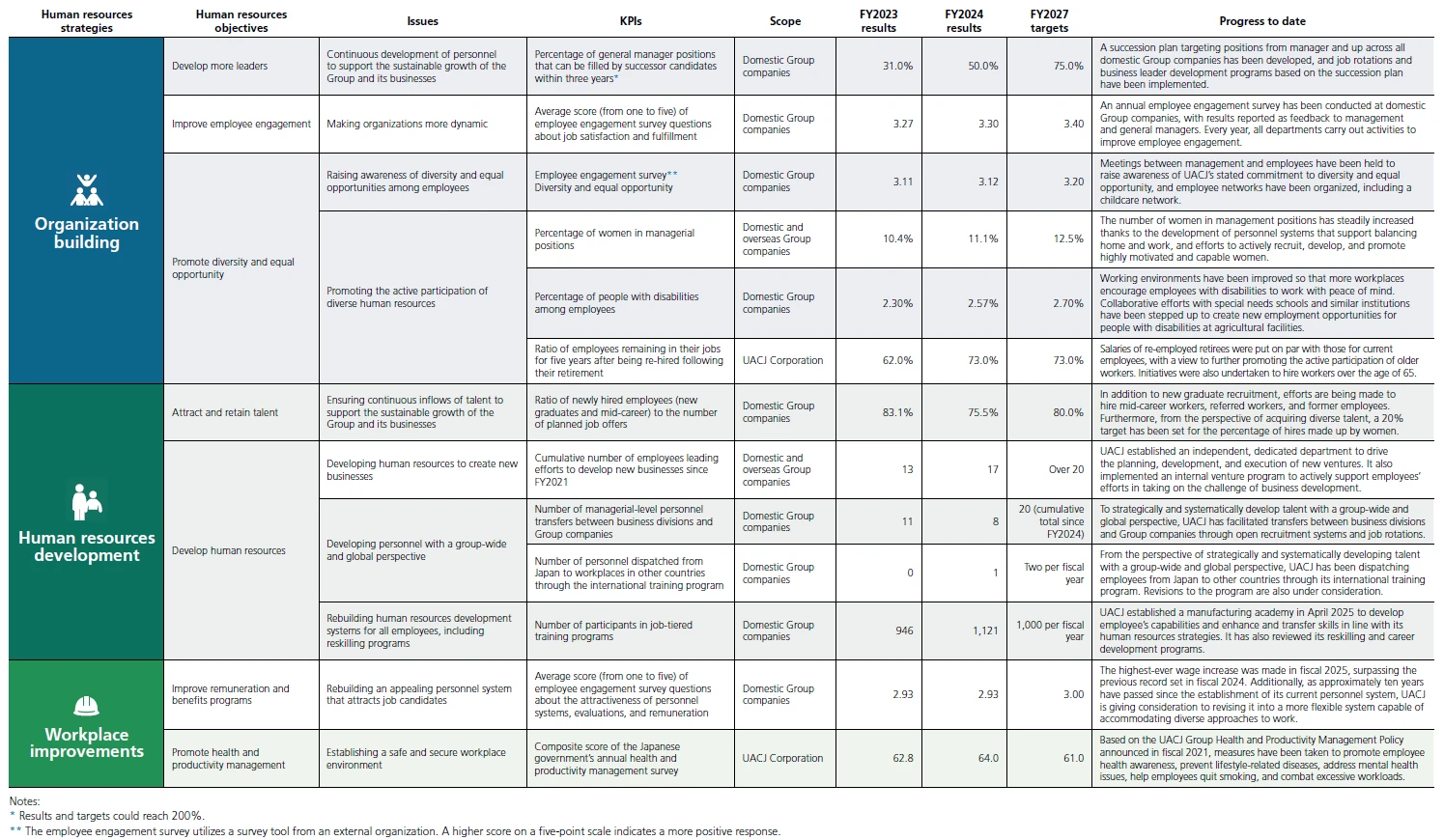
Among the measures under the three pillars of our human resources strategy—"organizational development," "personnel development," and "work environment development"—we define what "Well" means for employees and identify initiatives that enhance that "Well." By doing so, we aim to create a virtuous cycle between each employee’s "Well" and the enhancement of human and organizational capabilities. Our Group regards the entirety of these activities as human capital management.
We believe that advancing human capital management based on this approach is essential to realizing our Group’s corporate philosophy.
Alignment with business strategies
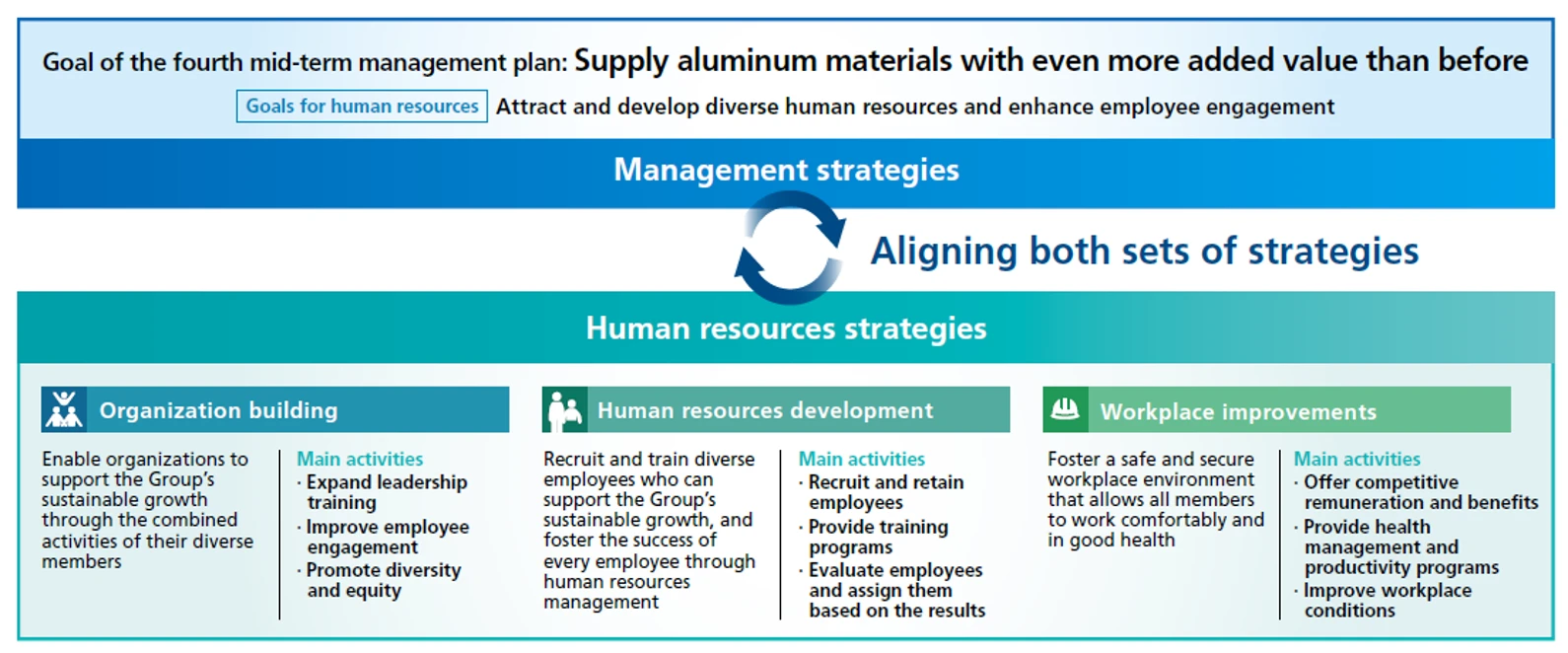
In our Fourth Medium-term Management Plan, which began in April 2024, our Group aims to transform from a materials provider to a provider of added value that offers "materials + alpha."
To build a solid human resources foundation that supports new value creation and stable business operations, we must "improve human resources capabilities" by acquiring and developing diverse talent, as well as "improve organizational capabilities" by increasing employee engagement.
With the goal of "enhancing human and organizational capabilities," we plan to implement various initiatives based on three human resources strategies: "organizational development," "personal development," and "work environment development." These include developing and expanding leaders, promoting Dei-ai, acquiring and retaining talent, establishing compensation and benefit systems, and promoting health management.
In particular, with regard to "enhancing human capabilities," we are currently visualizing the gap between the ideal human resources portfolio and the current situation at each department so as to realize our long-term management vision "UACJ VISION 2030." We aim to close this gap through human resources strategies scheduled for implementation starting in fiscal 2026.
Aligning management strategies and human resources strategies
Visualize the financial impact of human capital
How can a company increase its corporate value? We have set out our “value creation process” to increase corporate value through the use of six types of capital. We believe that initiatives addressing human capital are one key factor, and that employee awareness and various human resource policies have a significant impact in achieving higher financial performance and increasing corporate value.
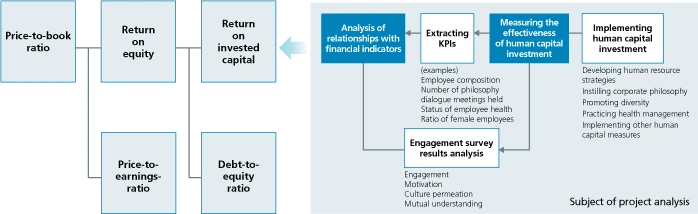
With this in mind, we are working to summarize the relationships between human capital, financial performance, and corporate value improvement, and have begun formulating measures to further enhance corporate value and exploring how we can best capitalize on these relationships. We believe that analyzing the correlations between financial indicators and human capital measures, such as various human resource policies, the promotion of diversity, and the practice of health management, should be used as a reference in developing human resource strategies to improve corporate value.
Currently, we conduct ongoing engagement surveys of our employees and apply the survey results to our business and organizational management. The results are communicated to each department, and by understanding changes in employee awareness, we are able to ascertain the effects of various personnel measures and the challenges we currently face. Taking this a step further, based on the relationship between human capital and improvements in business profits and capital efficiency, we are attempting to conduct analyses from the perspectives of what effect the enhancement of human capital achieved through the planning and implementation of human resource strategies has had, and what sort of actions would increase business profits and improve capital efficiency. By examining the link between human capital and corporate value in this way, we hope to pursue human capital measures that will improve ROIC, and ultimately PBR, in the future.
As part of this effort, since fiscal year 2023, we have been joined by the Nobuyuki Isagawa Laboratory and Kazuo Yamada Laboratory of Kyoto University, and are working together on a project to analyze the impact of human capital on financial performance. In the first fiscal year, the results of engagement surveys conducted to date at Nagoya Works, R&D Center, and Headquarters were analyzed in relation to diversity indicators such as the proportion of female employees, and to matters such as the workplace environment. In fiscal 2024, we plan to conduct a more fine-grained analysis, examine the content of the engagement survey, and set out the correlation between engagement scores and capital efficiency, as shown in the figure below. We will also expand the scope of analysis to cover other manufacturing sites. Based on these findings, we will unravel the correlation between engagement surveys and increased corporate value, thereby connecting these to enhanced human capital and well-being.
After summarizing the effects of human capital on enhancing corporate value and financial figures, we will use this information to develop and implement more effective human resource strategies that maximize the potential of our talent. We believe that proceeding with this project is a very important step in improving corporate value, and that it will prove to be very effective.
Coordination of management strategy and human resources strategy
Human capital evaluation indicators