


Leading a Circular Economy in Aluminum
 Share
ShareWhat the UACJ Group can Do

As a metallic material, aluminum is lightweight and consumes little energy when remelted,*1 giving it the advantage that recycling networks are readily established in society.
In aluminum recycling, every scrap is maximized—not only raw materials recovered from end-of-life products but also scrap generated in customers’ processing steps and scrap from the Company’s own material-production processes—in order to minimize virgin aluminum *2 usage. CO2 emissions are thereby cut across the entire product life cycle—from raw-material procurement through manufacturing, use, and disposal—while resource circulation that lightens the burden on nature is simultaneously realized. Also, aluminum that previously went unused or that was down-cycled is now returned as far as possible to the same products and reused repeatedly.
This horizontal recycling is an indispensable initiative for transforming the low-sustainability social and economic structures that run from mining to disposal into a society in which resources circulate.
UACJ is leading the shift to a sustainable society in which aluminum circulates.
- Energy required to recycle aluminum is approximately 3% of that needed to produce virgin aluminum.
- Virgin ingot is the raw aluminum obtained via the electrolytic smelting of alumina extracted from mined bauxite.
Our Contribution to the SDGs
Opportunities and Risks
| Opportunities | Risks |
|---|---|
|
|
Our Vision, Targets, and Progress
Our commitment
We play a central role in promoting aluminum recycling by combining forward material flows (providing materials to manufacturers) and reverse material flows (collecting various types of scrap and reuse it as raw material).
Targets to be achieved by FY2030
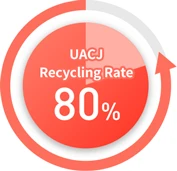
- UACJ Recycling Rate = Amount of recycled aluminum / Amount of aluminum loaded into crucibles (excluding pure aluminum)
Goals and progress
| Issue to be addressed | Evaluation indicator | Fiscal 2024 | Fiscal 2025 target |
Fiscal 2030 target |
Fiscal 2050 target |
|
|---|---|---|---|---|---|---|
| target | results | |||||
| Maximize recycling rate of aluminum alloys | UACJ Recycling Rate*1 | 73% | 73.9% | 74.1% | 80% | 100% |
- Scope:Flat Rolled Products Business Extrusion & Metal Components Business
Related major initiatives
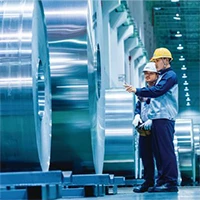
UACJ's Vision for Building an Aluminum Circular Society
We recycle aluminum cans, reuse automobile scrap, and recycle aluminum within UACJ to create a society where aluminum is recycled.