

Climate-related Disclosures (TCFD)
 Share
ShareGovernance
We stipulate our basic concepts and approaches for promoting climate change countermeasures and other sustainability activities within our "Sustainability Basic Policy." Additionally, the "UACJ Group Environmental Basic Policy" (revised in March 2025) also stipulates the environmental "Philosophy" and "Action Guidelines" (including climate change countermeasures).
The Climate Change Countermeasure Steering Committee, established on April 1, 2021, was renamed the Environmental Committee in fiscal 2024. Chaired by the president, the committee organizes working groups for specific initiatives, including control organization, carbon neutral measures, recycling, conversion to aluminum, and procurement of raw materials. In fiscal 2024, the committee added initiatives for the circular economy, nature positive, green technology and environmental management. The committee reports important results of the working groups’ examinations and activities at management meetings and the Board of Directors to receive management decisions, which ensures direct governance of our activities.
Strategy
We conducted a scenario analysis in fiscal 2021 with reference to future projections by the International Energy Agency, the UN Intergovernmental Panel on Climate Change, and other organizations. We confirmed that under the 1.5°C scenario, the positive impact would be greater if future implementation of response measures and new opportunities are combined. "Taking measures to address climate change" has been one of our Group’s Materialities since fiscal 2021. After reorganizing our Materialities in fiscal 2023 based on the results of the scenario analysis, we once again made "taking measures to address climate change" a Materiality, and we are working to reduce $\text{GHG}$ emissions accordingly.
In addition, we have positioned the promotion of recycling as an important strategy in our current midterm management plan, which commenced in fiscal 2024. Recycling aluminum, encouraging its widespread use, and recycling used aluminum as resources for new products (closed-loop recycling) will lead to a reduction in GHG emissions. Moreover, by curbing the mining of bauxite, the raw material for new ingots, it will also help reduce the GHG emissions involved in the mining process. Building this kind of circular economy and contributing to Nature Positive initiatives are also Materialities for us, so we are implementing climate change countermeasures as an important management policy.
Businesses Covered in Scenario Analysis
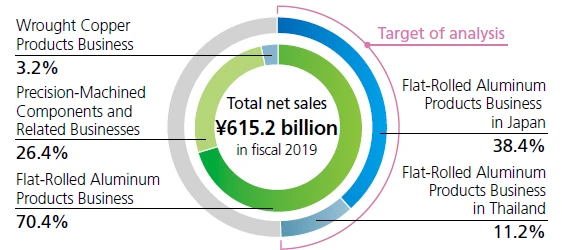
Sectors covered by scenario analysis
| Sector 1 | Sector 2 | Products |
|---|---|---|
| Rolled Aluminum Products Business | Flat-rolled aluminum business | Beverage products (can body and lid materials) Automotive (panels, heat exchanger materials) |
| Extrusion business | Automotive (frames, heat exchangers and piping) IT products |
|
| Aluminum foil business | Pharmaceuticals, food packaging, batteries | |
| Casting and forging business | Automotive (compressor wheels, vehicle air conditioning parts) | |
| Precision-machined Components and Related Businesses | Automotove parts business | Atutomotive (bumpers, sunroof guides) |
| Precision-machined components business | Construction, industrial machinery |
Risks
Transition Risk
- Strategy: Carbon pricing, regulations (for recycling, water consumption, etc.)
- Market: Energy price fluctuations, sharp increases in raw material prices
- Reputation: Customer behavior changes, company reputation changes among investors
Physical Risk
- Persisting: Rising average temperature
- Acute: Extreme weather events
Scenario Analysis Outcomes and Implications
Following risk severity assessments (risks and opportunities), we are analyzing two scenarios of 1.5°C and 4°C temperature increases.
Action Plans and Details
Scenario Analysis Covering All Group Companies
- The current scenario analysis focused on the flat rolled products business and the operations in Japan and Thailand. The analysis methods used will be developed to cover all Group companies.
- The project team will be used to lead task forces and working groups to be deployed throughout the Group and at all levels of business.
Monitoring and Execution System
- The current analysis focused on two scenarios. Given the high degree of uncertainty surrounding climate change, we will regularly monitor forecasts, conduct impact assessments, and review our strategies.
- A special team was formed for the project to address climate change risk. We intend to give the team an official organization role to ensure the initiative remains a permanent part of our operations.
Increasing the Depth of Analysis
- We consider the current scenario analysis to have been Level 1, and we intend to incrementally deepen the analysis to Level 2 and Level 3.
Risks and Opportunities
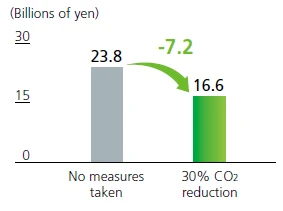
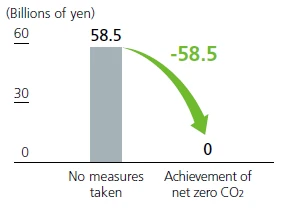
In fiscal 2023, we calculated and disclosed for the first time the financial impact in the event a carbon tax is introduced in Japan, Thailand, and other countries. We review these calculations annually in light of carbon-pricing trends at home and abroad. In the latest calculation, comparing Scope 1 and 2 outcomes for the case where we achieve our targets of reducing CO2 emissions 30% from fiscal 2019 levels by fiscal 2030 and reaching carbon neutrality by fiscal 2050 versus the case where we do not, the financial benefit from GHG reductions (avoided carbon-tax cost) is estimated at approximately ¥7.2 billion in fiscal 2030 and approximately ¥58.5 billion in fiscal 2050.
Risk significance assessment: risks and opportunities
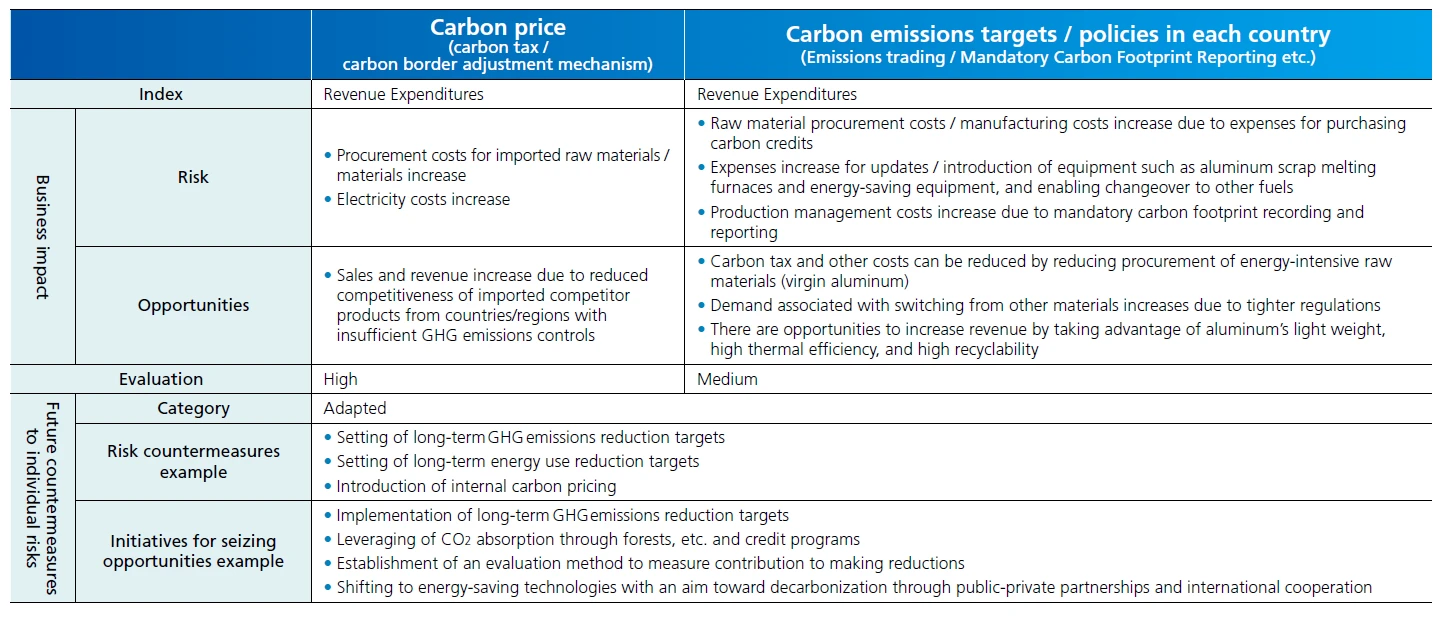
Financial Impact Assessment of Carbon Tax
2030
2050
Key Performance Indicators and Targets
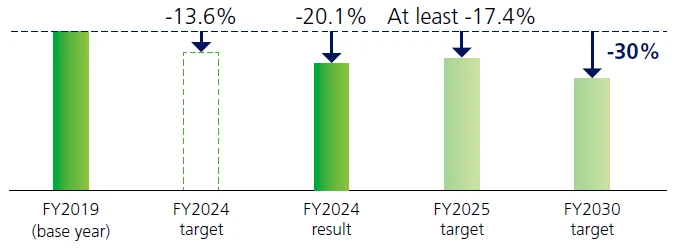
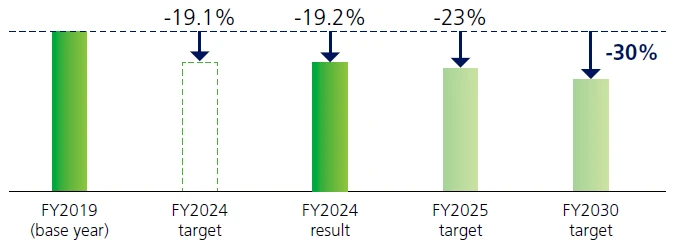
In June 2022, we announced our challenge to achieve carbon neutrality in Scope 1 and 2 by 2050 and, as a milestone on that path, our aim to reduce CO2 emissions by 30%*3 in fiscal 2030. For Scope 3, in December 2023 we announced the goal of aiming to reduce CO2 emissions by 30%*4 in fiscal 2030 through expansion of recycling and, by 2050, minimizing GHG emissions by collaborating with various supply-chain partners to maximize recycling and reduce GHG emissions throughout the entire supply chain.
Trends in Scope 1 and 2 CO2 Emissions Intensity Reduction Rate
Trends in Scope 3 CO2 Emissions Intensity Reduction Rate