


Actions toward a Decarbonized Society
 Share
Our Approach
Addressing climate change has become an urgent issue that society as a whole must tackle. To fulfill this responsibility, we have positioned the realization of carbon neutrality—including the reduction of greenhouse gas (GHG) emissions—as one of our material issues. We will contribute to reducing GHG emissions across society and to building a sustainable society not only by reducing GHG emitted through our own business activities but also by expanding opportunities for the utilization of aluminum.
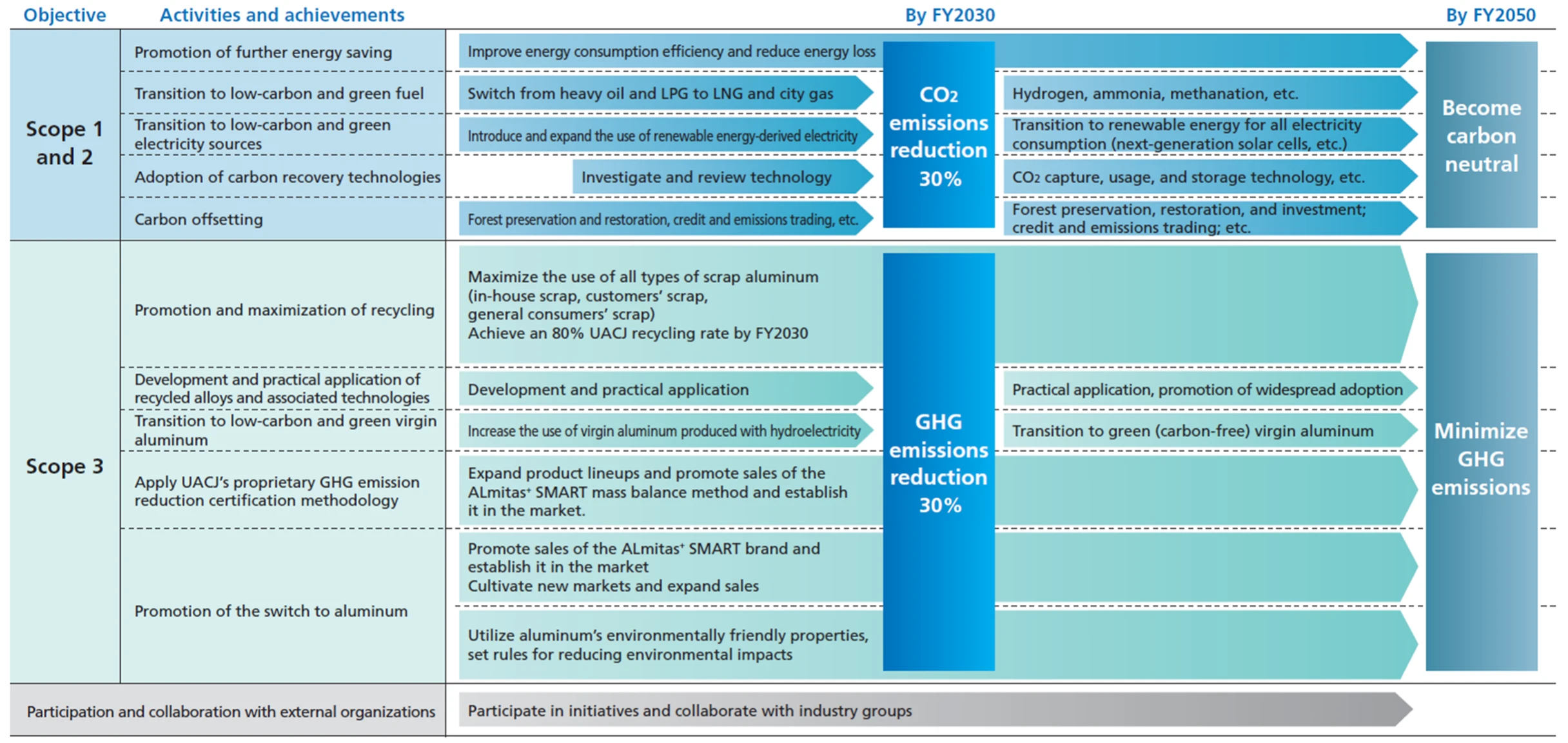
To ensure the effectiveness of these initiatives, we have developed a roadmap targeting carbon neutrality (CN) for Scope 1 and 2 emissions by fiscal 2050. As an interim milestone for fiscal 2030, we have set a goal to reduce our CO2 emission intensity by 30% compared to fiscal 2019. This includes the implementation of "100% renewable energy-powered plants"—an initiative launched in fiscal 2023—where all electricity consumed at 19 of our domestic sites (primarily those manufacturing products close to the final-product stage) is sourced from 100% renewable energy. Furthermore, regarding Scope 3 emissions, we have set a target to achieve a 30% reduction in emission intensity (for Category 1) by fiscal 2030, compared to fiscal 2019, and we are actively pursuing measures to reach this goal, such as by promoting recycling.
Roadmap for Addressing Climate Change
Participating in the GX Future Consortium・GX Future League for Climate Action
Starting in fiscal 2024, we joined the "GX League" (GXL)—a framework comprising various companies and organizations committed to achieving carbon neutrality. The GXL serves as a collaborative platform for industry, academia, and government, working toward the Japanese government’s target of reducing greenhouse gas (GHG) emissions by 46% by fiscal 2030 (compared to fiscal 2013 levels). Following the conclusion of the GXL’s activities at the end of fiscal 2025, we transitioned to its successor entities—the "GX Future Consortium" (GXFC) and the "GX Future League" (GXFL)—beginning in fiscal 2026.
Our CO2 and GHG reduction targets in the GX League (Scope 1 & 2 total) are an average 19% cut for fiscal 2024–2025 and a 30% cut for fiscal 2030 (baseline: three-year average fiscal 2014–2016). This plan has received GX League Secretariat approval.
Climate-related Disclosures (TCFD)
In September 2021, we declared our support for the recommendations of the Task Force on Climate-related Financial Disclosures (TCFD), and we joined the TCFD Consortium. We were also selected for the Ministry of the Environment’s "Fiscal 2021 TCFD-aligned Climate Risk & Opportunity Scenario Analysis Support Project," which promotes the integration of climate-related risks and opportunities into management strategy. Based on TCFD recommendations, we actively disclose the risks and opportunities that climate change poses to our business from the four perspectives of governance, strategy, risk management, and metrics & targets.
Key Initiatives
CO2Emissions Trends
In fiscal 2025, the Group’s energy consumption reached 5,331 GWh★, an increase of approximately 1.8% compared to fiscal 2024. The Group’s CO2 emissions totaled 888,000 t-CO2—comprising 529,000 t-CO2★ for Scope 1 and 359,000 t-CO2★ for Scope 2 (market-based)—representing a decrease of approximately 1,000 t-CO2 from fiscal 2024. Furthermore, the Group’s CO2 emissions intensity stood at 0.874 t-CO2 per ton of product, a reduction of approximately 3.2% compared to fiscal 2024. Additionally, Scope 2 CO2 emissions calculated using the location-based amounted to 448,000 t-CO2★. The improvement in emissions intensity is attributed to an increase in production volume during fiscal 2025, as well as the steady implementation of CO2 reduction initiatives and various other improvement activities.
- Figures for fiscal 2025 marked with a ★ have been verified by a third party.
UACJ Group Scope1・2 CO2 Emissions (Japan + overseas) *1
| Fiscal 2019 |
Fiscal 2020 |
Fiscal 2021 |
Fiscal 2022 |
Fiscal 2023*5 |
Fiscal 2024*5 |
Fiscal 2025 |
||
|---|---|---|---|---|---|---|---|---|
| Fuel Scope 1 CO2 emissions*2 (thousand tons CO2) |
ー | 514 | 493 | 557 | 528 | 494 | 521 | 529*6★ |
| Electricity Scope 2 CO2 emissions (thousand tons CO2) |
Location-based | 492 | 446 | 479 | 480 | 447 | 450 | 448★ |
| Market-based*4 | ー | ー | ー | ー | 367 | 368 | 359★ | |
| Scope 1+2 CO2 emissions (thousand tons CO2) |
Location-based | 1,005 | 939 | 1,037 | 1,008 | 941 | 971 | 977 |
| Market-based*4 | ー | ー | ー | ー | 861 | 889 | 888 | |
| CO2 emissions per product ton*3 (t-CO2/product ton) |
Location-based | 1.118 | 1.109 | 0.999 | 0.998 | 1.030 | 0.981 | 0.958 |
| Market-based*4 | ー | ー | ー | ー | 0.947 | 0.903 | 0.874 |
- Companies and sites as of September 30, 2026
-
Measurement scope is :
(Japan : 30 sites) UACJ (Nagoya(Flat Rolled), Fukui, Fukaya, Nagoya(Extrusion), Oyama, Foundry & Forging), UACJ Extrusion Anjo Corporation, UACJ Extrusion Shiga Corporation, UACJ Extrusion Gunma Corporation, UACJ Foil Corporation (Shiga, Nogi, Isesaki), Nikkin Co., Ltd. , UACJ Metal Components Corporation (Sendai, Narita, Ena, Shiga, Hiroshima, Koriyama), UACJ Aluminum Center Corporation (Utsunomiya, Fukaya, Shiga, Nara, Anjo), Izumi Metal Corporation (Yamagata, Tochigi, Noda, Kawasaki), Kamakura Industry Co., Ltd., UACJ Yamaichi Aluminum Can Recycling Corporation.
(Overseas : 15 sites) UACJ (Thailand) Co., Ltd., UACJ Extrusion Czech s.r.o., UACJ Extrusion (Thailand) Co., Ltd., UACJ Foundry & Forging (Vietnam) Co., Ltd., UACJ Foil Malaysia Sdn. Bhd., UACJ Automotive Whitehall Industries, Inc.(6th Street、Madison、Progress Drive、Paducah、Flagstaff、Mexico), UACJ Metal Components Mexico, S.A. de C.V., UACJ Metal Components Central Mexico, S.A. de C.V., UACJ Metal Components (Thailand) Co., Ltd, P.T. Yan Jin Indonesia.
for a total of 45 sites. - For overseas facilities, as country-specific fuel emission factors are unavailable, fuel emission factors for Japan are used as a substitute.
-
Measurement scope is :
(Japan : 13 sites) UACJ (Nagoya(Flat Rolled), Fukui, Fukaya, Nagoya(Extrusion), Oyama, Foundry & Forging), UACJ Extrusion Anjo Corporation, UACJ Extrusion Shiga Corporation, UACJ Extrusion Gunma Corporation, UACJ Foil Corporation (Shiga, Nogi, Isesaki), UACJ Aluminum Center Corporation (Utsunomiya)
(Overseas : 11 sites) UACJ (Thailand) Co., Ltd., UACJ Extrusion Czech s.r.o., UACJ Extrusion (Thailand) Co., Ltd., UACJ Foundry & Forging (Vietnam) Co., Ltd., UACJ Foil Malaysia Sdn. Bhd., UACJ Automotive Whitehall Industries, Inc. (6th Street、Madison、Progress Drive、Paducah、Flagstaff、Mexico)
for a total of 24 sites. - For overseas facilities, as emission factors specific to individual electric utility companies are unavailable, country-specific emission factors from "IEA Emission Factors 2025" are used as a substitute.
- Due to errors in certain data aggregation and emissions calculations, the figures for fiscal 2023 and fiscal 2024 have been corrected.
- For domestic city gas, in cases where Japan's Ministry of the Environment has not published an emission factor for a specific gas company, an alternative value (an emission factor specified by ministerial ordinance) is used.
UACJ (Non-consolidated) Scope 1・2 CO2 Emissions*7
| Components | Fiscal 2023*8 | Fiscal 2024*8 | Fiscal 2025 | |
|---|---|---|---|---|
| Fuel Scope 1 CO2 emissions (t-CO2/yr.) |
ー | 343 | 345 | 350 |
| Electricity Scope 2 CO2 emissions (t-CO2/yr.) Location-based |
Location-based | 267 | 260 | 264 |
| Market standard | 227 | 218 | 201 | |
| Scope 1+2 CO2 emissions (t-CO2/yr.) |
Location-based | 610 | 605 | 614 |
| Market standard | 570 | 563 | 551 | |
| CO2 emissions per product ton (t-CO2/product ton) |
Location-based | 1.044 | 1.010 | 0.995 |
| Market standard | 0.976 | 0.940 | 0.893 | |
- Measurement scope is :
UACJ (Nagoya(Flat Rolled), Fukui, Fukaya, Nagoya(Extrusion), Oyama, Foundry & Forging) for a total of 6 sites. - Due to errors in certain data aggregation and emissions calculations, the figures for fiscal 2023 and fiscal 2024 have been corrected.
UACJ Group Scope3 CO2 Emissions (Japan + overseas) (Thousand t-CO2eq/year)
| Components*9 | Fiscal 2019*15 | Fiscal 2020 | Fiscal 2021 | Fiscal 2022 | Fiscal 2023 | Fiscal 2024 | Fiscal 2025 |
|---|---|---|---|---|---|---|---|
| Category 1: Purchased goods and services*10 | 5,424 | 5,260 | 6,123 | 5,313 | 4,524 | 5,079 | 4,979 |
| Category 2: Capital goods*11 | 172 | 63 | 73 | 93 | 116 | 147 | 185 |
| Category 3: Fuel- and energy-related activities (not included in scope 1 or scope 2)*12 | 167 | 145 | 160 | 132 | 143 | 144 | 148 |
| Category 4: Upstream transportation and distribution*12 | 92 | 90 | 97 | 114 | 106 | 116 | 123 |
| Category 5: Waste generated in operations*13 | ー | ー | ー | 0.4 | 0.4 | 0.4 | 0.4 |
| Category 6: Business travel*11 | ー | ー | ー | 1 | 1 | 1 | 1 |
| Category 7: Employee commuting*13 | ー | ー | ー | 2 | 2 | 2 | 2 |
| Category 12: End-of-life treatment of sold products*14 | ー | ー | ー | ー | 0.1 | 0.1 | 0.1 |
| Total | 5,855 | 5,558 | 6,453 | 5,655 | 4,893 | 5,490 | 5,439★ |
- Figures for fiscal 2025 marked with a ★ have been verified by a third party.
- The following company and business site names are as of September 30, 2026
- We have classified emissions according to the categories defined in the GHG Protocol Scope 3 Standard and its associated guidance. Note that Category 8 is accounted for under Scope 1 and 2; Categories 9 and 10 are excluded due to the difficulty of obtaining data; and Categories 11 and 13–15 are excluded as they have little relevance to our business operations.
- Measurement scope is:
(Japan : 13 sites) UACJ (Nagoya(Flat Rolled), Fukui, Fukaya, Nagoya(Extrusion), Oyama, Foundry & Forging), UACJ Extrusion Anjo Corporation, UACJ Extrusion Shiga Corporation, UACJ Extrusion Gunma Corporation, UACJ Foil Corporation (Shiga, Nogi, Isesaki), UACJ Aluminum Center Corporation (Utsunomiya)
(Overseas : 8 sites) UACJ (Thailand) Co., Ltd., UACJ Extrusion Czech s.r.o., UACJ Automotive Whitehall Industries, Inc.(6th Street、Madison、Progress Drive、Paducah、Flagstaff、Mexico)
for a total of 21 sites. - The scope of the data includes UACJ and all group companies.
- Measurement scope is:
(Japan : 13 sites) UACJ (Nagoya(Flat Rolled), Fukui, Fukaya, Nagoya(Extrusion), Oyama, Foundry & Forging), UACJ Extrusion Anjo Corporation, UACJ Extrusion Shiga Corporation, UACJ Extrusion Gunma Corporation, UACJ Foil Corporation (Shiga, Nogi, Isesaki), UACJ Aluminum Center Corporation (Utsunomiya)
(Overseas : 1 site) UACJ (Thailand) Co., Ltd.
for a total of 14 sites. - Measurement scope is:
UACJ (Nagoya(Flat Rolled), Fukui, Fukaya, Nagoya(Extrusion), Oyama, Foundry & Forging), UACJ Extrusion Anjo Corporation, UACJ Extrusion Shiga Corporation, UACJ Extrusion Gunma Corporation, UACJ Foil Corporation (Shiga, Nogi, Isesaki), UACJ Aluminum Center Corporation (Utsunomiya)
for a total of 13 sites. - Measurement scope is:
UACJ (Nagoya(Flat Rolled), Fukui, Fukaya)
for a total of 3 sites. - FY2019 results have not undergone third-party assurance.
Main Initiatives in Production Processes
New Energy Saving Subcommittee
The UACJ Group Energy Saving Subcommittee meets regularly to promote energy-saving activities at business sites. Beginning in FY2022, we created the New Energy Saving Subcommittee with a revised member makeup and meeting schedule with the aim of stepping up our activities to reduce GHG emissions and promote energy conservation.
Examples of Energy-Saving Activities
The table below shows the main energy-saving activities implemented by the UACJ Group in fiscal 2025.
Examples of CO2 Emissions Reductions (New for fiscal 2025)
| Theme | CO2 Emissions Reduction Impact (t-CO2/yr.) |
|---|---|
| Optimization of the production process (improvement of manufacturing methods) | 5,034 |
| Upgrading to energy-efficient equipment | 2,482 |
| Switching to LED Lighting | 515 |
Switching to LNG as a Heat Source for Production Processes
Using LNG as a heat source produces approximately 30% less CO2 emissions compared to LNG and heavy oil with the same calorific value.
As of the end of fiscal 2025, LNG (including city gas) accounted for approximately 92% of the fuel used by the UACJ Group on a calorific value basis.
Introduction of renewable energy-derived electricity
The UACJ Group*16 is systematically implementing the adoption of renewable energy. In fiscal 2025, the Group sourced 250 million kWh★ of renewable energy—across both domestic and international operations—through Power Purchase Agreements (PPAs), dedicated renewable energy utility plans, and renewable energy certificates (non-fossil fuel certificates and I-RECs). This brings the share of renewable energy in the Group’s total electricity consumption to 23.4%★. These initiatives result in an annual reduction of approximately 106,000 t of CO2 emissions*17. Notably, 19 of the Group’s domestic sites*18 have transitioned to operating on 100% renewable energy—a status they have maintained since fiscal 2023.
- Figures for fiscal 2025 marked with a ★ have been verified by a third party.
- Measurement scope is :
(Japan : 30 sites) UACJ (Nagoya(Flat Rolled), Fukui, Fukaya, Nagoya(Extrusion), Oyama, Foundry & Forging), UACJ Extrusion Anjo Corporation, UACJ Extrusion Shiga Corporation, UACJ Extrusion Gunma Corporation, UACJ Foil Corporation (Shiga, Nogi, Isesaki), Nikkin Co., Ltd. , UACJ Metal Components Corporation (Sendai, Narita, Ena, Shiga, Hiroshima, Koriyama), UACJ Aluminum Center Corporation (Utsunomiya, Fukaya, Shiga, Nara, Anjo), Izumi Metal Corporation (Yamagata, Tochigi, Noda, Kawasaki), Kamakura Industry Co., Ltd., UACJ Yamaichi Aluminum Can Recycling Corporation.
(Overseas : 15 sites) UACJ (Thailand) Co., Ltd., UACJ Extrusion Czech s.r.o., UACJ Extrusion (Thailand) Co., Ltd., UACJ Foundry & Forging (Vietnam) Co., Ltd., UACJ Foil Malaysia Sdn. Bhd., UACJ Automotive Whitehall Industries, Inc.(6th Street、Madison、Progress Drive、Paducah、Flagstaff、Mexico), UACJ Metal Components Mexico, S.A. de C.V., UACJ Metal Components Central Mexico, S.A. de C.V., UACJ Metal Components (Thailand) Co., Ltd, P.T. Yan Jin Indonesia.
for a total of 45 sites. - The calculation was performed using a CO2 emission factor of 0.423 kg-CO2/kWh, which is the national average value for Japan for fiscal 2025.
- UACJ (Foundry & Forging), UACJ Extrusion Anjo Corporation, UACJ Extrusion Shiga Corporation, UACJ Extrusion Gunma Corporation, UACJ Metal Components Corporation (Sendai, Narita, Ena, Shiga, Hiroshima, Koriyama), UACJ Aluminum Center Corporation (Utsunomiya, Shiga, Nara, Anjo), Izumi Metal Corporation (Yamagata, Tochigi, Noda, Kawasaki), Kamakura Industry Co., Ltd.,
- Companies and sites as of September 30, 2026.
Main Initiatives in Logistics
As a "specified consignor" under Japan's Act on the Rational Use of Energy, UACJ has set a target to improve energy efficiency—measured in terms of transport ton-kilometers—by an average of 1% annually over a five-year period. To achieve this, we are promoting energy conservation within logistics operations through initiatives such as modal shifts and the enhancement of loading efficiency. Moving forward, we remain committed to optimizing transport efficiency and reducing CO2 emissions across the entire supply chain.
Main Initiatives in Offices
Energy-Saving Activities in Offices
UACJ takes active steps to reduce energy consumption in its offices, including by controlling temperatures maintained by air conditioner systems following the Cool Biz and Super Cool Biz campaigns as strictly enforcing turning off of lights and electronic equipment when not in use.
At the head office, we introduced a hot-desking system in January 2022, eliminating individual, dedicated desks. In July 2022, the head office functions of affiliated companies were consolidated into the same office building as UACJ. In December 2025, the head office relocated to the Sumitomo Fudosan Tokyo Mita Garden Tower, a facility that has earned "ZEB Ready" certification under Japan's "Building-Housing Energy-efficiency Labeling System (BELS)." Through these measures, we have improved office space efficiency and are achieving energy savings in air conditioning, lighting, and the use of electronic equipment.
Office-Based Environmental Protection Measures
For office supplies, we are proactively sourcing items that comply with the Law Concerning the Promotion of Procurement of Eco-Friendly Goods and Services by the State and Other Entities and eco-mark items.
External Recognition and Evaluation
Voluntary participation in the CDP
Voluntary participation in the international climate-action initiative CDP (Carbon Disclosure Project) yields objective evaluation of our greenhouse-gas management level while raising our activity standards. As an example, we calculate greenhouse-gas emissions per GHG Protocol definitions—Scope 1 (direct emissions from in-house fuel combustion), Scope 2 (indirect emissions from electricity used in-house), and Scope 3 (upstream and downstream emissions across the entire supply chain)—and we publish them this website.