


UACJ Group's Materiality
 Share
SharePassing down a “Lighter World” over the next century
Sustainability Compass
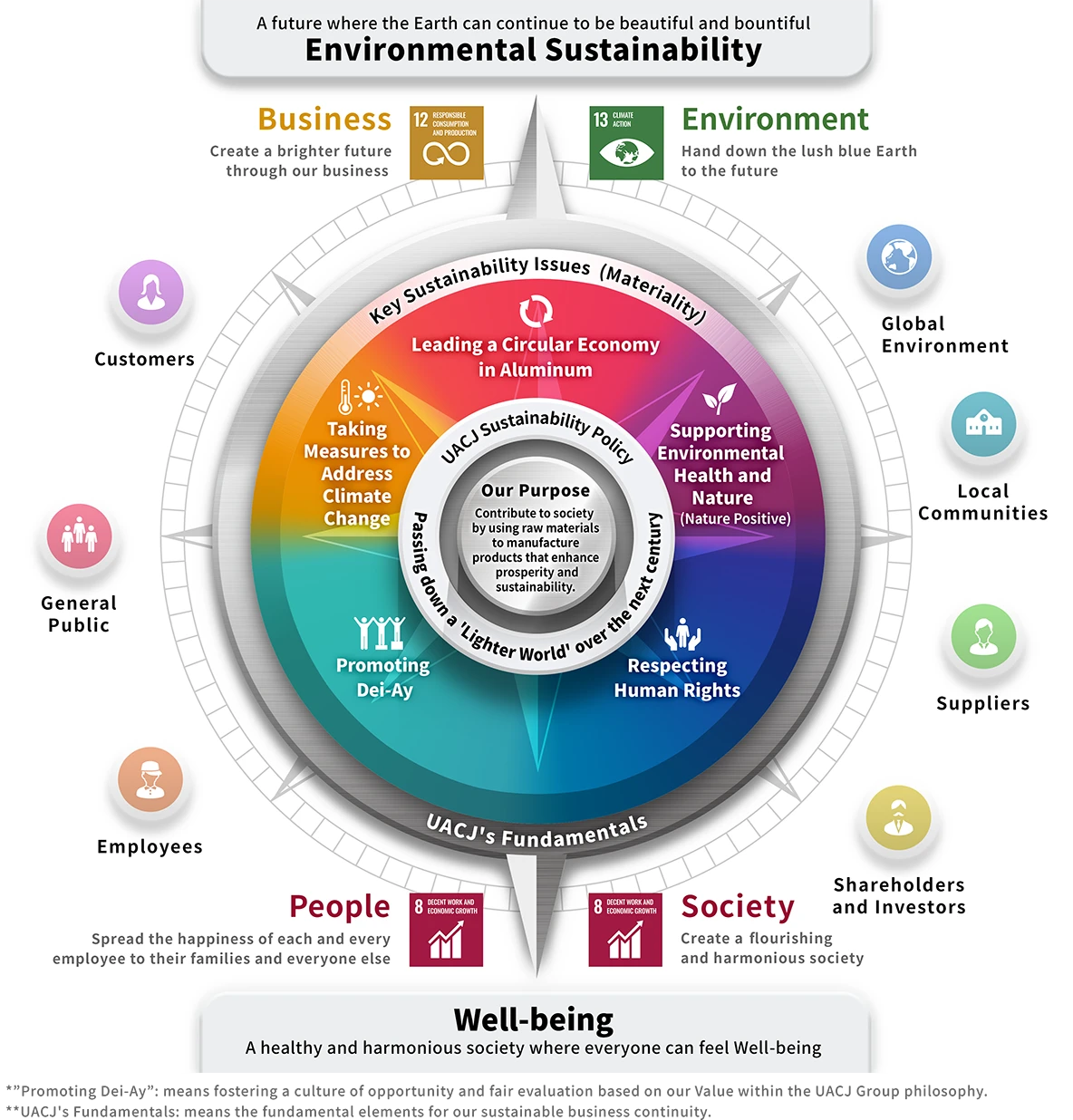
With the aim of growing together with a sustainable society, the UACJ Group has identified sustainability key issues as "Materiality" to be addressed by the entire group over the medium to long term.
It has identified three environmental materialities aimed at "A future where Earth can continue to be beautiful and bountiful" and two well-being materialities aimed at "A healthy and harmonious society where everyone can feel well-being." To realize " A “Lighter World” over the next century," as aimed at for by the Company, it promotes initiatives across the entire supply chain—not only within the group—while confirming progress and steadily advancing toward goal achievement.
Materialities are watched on a timely basis for changes in the internal and external environments and are reorganized at the proper timing. This is regarded as necessary to achieve both the sustainability of the "environment, society, and economy" in response to changes in the times and the sustainable growth of the UACJ Group.
A Future where the Earth can Continue to be Beautiful and Bountiful
A Healthy and Harmonious Society where Everyone can Feel Well-being
Five materialities
A Future where the Earth can Continue to be Beautiful and Bountiful



A Healthy and Harmonious Society where Everyone can Feel Well-being


Basic approach
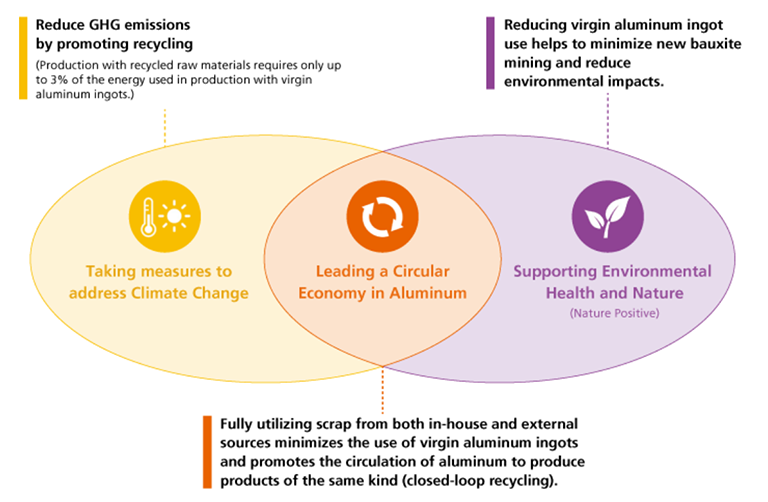
In order to realize "a future where Earth can continue to be beautiful and bountiful," UACJ has identified the following three items as environmental materiality issues: "Leading a Circular Economy in Aluminum", "Taking Measures to Address Climate Change," and "Supporting Environmental Health and Nature (Nature Positive)." These three materiality issues are interrelated, mutually supportive, and fused into a whole.
Out of these, it is “leading a circular economy in aluminum” that plays the central role. Recycling aluminum, promoting its use more widely, and recycling aluminum into the same products (closed loop recycling) will not only reduce GHG emissions and thus help address climate change, but also reduce the amount of new ingots used, which will curb the mining of new bauxite, in turn helping to support environmental health and nature (Nature Positive). In this way, maximizing the environmental performance of aluminum and reducing environmental impact through its use is our unique contribution to the environment and the value we provide. Among these initiatives, the central focus is on "Leading a Circular Economy in Aluminum".
To promote these issues, UACJ aims to "build a society where aluminum is recycled" by pursuing aluminum recycling in various fields.
The Process of Identifying Materiality
We began our materiality identification activities in 2019. Potential sustainability key issues were reviewed and prioritized from two perspectives: importance to the UACJ Group and importance to stakeholders. In addition, based on exchange of views with experts, Materialities were identified through procedures in accordance with appropriate governance.
Subsequently, due to changes in the domestic and overseas situation, including the spread of COVID-19 after the COVID-19 disaster and changes in the overseas situation, the social system underwent a major transformation, and we determined that Materialities needed to be reviewed. Therefore, as indicated below, we re-identified it in 2023 and will implement it from 2024.
01
Verification of implementation results for the existing six Materialities and Identification of new issues
02
Analysis of recent societal demands and key issues within the Environmental, Social, and Economic domains
03
Assessment of the impact on our business from both a Risk and Opportunity perspective, based on Significance and Urgency
04
Narrowing Down the candidate Materialities from the three perspectives of Internal Environment, External Demands, and Business Impact
05
Verification of candidate Materialities through dialogue with Outside Directors and relevant Executives
06
Determination of the final direction of the Materiality themes following deliberation by the Management Team
07
Finalization of issues, implementation measures, Key Performance Indicators (KPIs), and target values for each Materiality, following approval by the Management Team
08
Final Deliberation and Resolution by the Board of Directors
Definition of the UACJ Group's Materiality
In the UACJ Group, we define "Materiality" as significant issues related to environmental, social, or economic sustainability that significantly impact our medium to long-term business and meet the following three requirements:
Environmental, economic and social issues
- that have a significant impact on stakeholders;
- that the UACJ Group recognizes as important and prioritizes in resource allocation;
- that will create social and economic value over the medium to long term.
- In reviewing our Materialities for FY2023, we have identified "Occupational Health and Safety" and "Product Quality Assurance" as UACJ Group's Fundamental Elements (UACJ Standards). This designation was made because these critical issues will continue to serve as the foundation of the UACJ Group's business 100 years from now. Accordingly, the Health and Safety Committee and the Quality Committee will continue to manage the progress of these initiatives.
Steps toward achieving the UACJ Group's five materiality targets
To realize a lighter world, the UACJ Group—both up to now and with a view toward the next 100 years—advances initiatives across the entire supply chain under our Sustainability Policy, steadily progressing toward our goals while confirming progress.
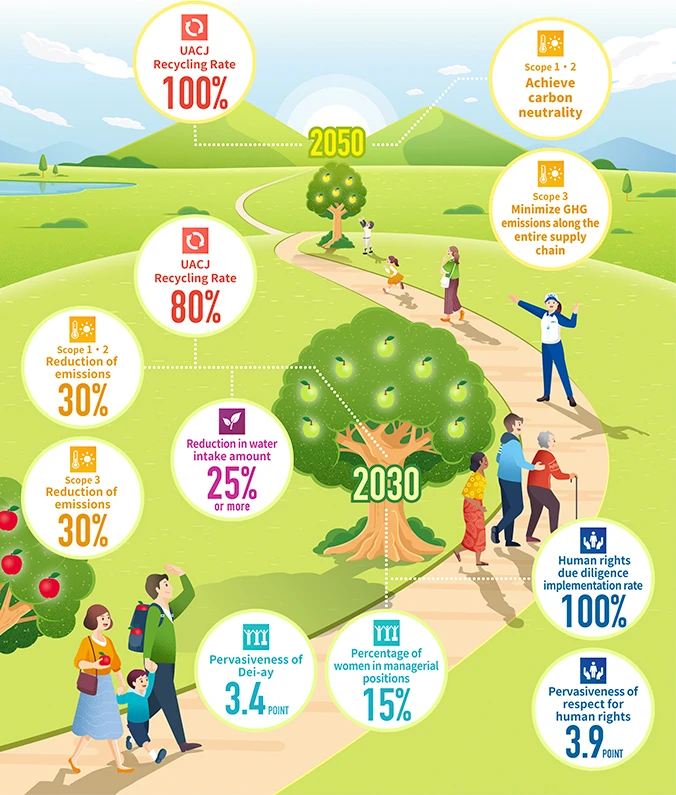
Steps toward achieving the UACJ Group's five materiality targets KB