


Flat Rolled Products
Aluminum Alloy Sheets for Closures (Beverage Container Caps)
 Share

Caps for Beverage Bottle Cans, Glass Bottles and Other Containers
Closures (stoppers) are the items that close various types of container. Aluminum closures are used to seal a wide variety of glass bottles and bottle cans for soft drinks, nutritional drinks and the like. We provide closure sheet materials to meet customer needs for closures that protect a container's contents, open easily and are highly convenient.
Features
- To ensure the performance characteristics required by customers—such as "opening capability" and "optimal earing"—we produce materials tailored to specific needs by precisely controlling alloy composition, rolling temperatures and durations, and annealing temperatures.
- Upon request, we can also apply surface treatments to enhance adhesion with coatings or paints.
- We maintain strict control over flatness and squareness to prevent issues during the printing process, such as color gapping, unevenness, or print misalignment.
Product Characteristics
| Alloy | Applications | Features |
|---|---|---|
| 8011 | General-purpose materials | An alloy with excellent workability, suitable for products of various shapes |
| 3105 | General-purpose materials | An alloy offering an excellent balance of workability and strength, suitable for a wide range of products |
| 3104 | Bottle-can caps | A high-strength alloy that is similar to the material used for the bodies of bottle-shaped cans |
| 5151 | Bottle-can caps | A high-strength alloy that is well-suited to the performance requirements of bottle-shaped cans |
| 5052 | Maxi-caps, etc. | A high-strength alloy that can also be used for wide-mouthed products |
Cap Production Process
Printing process

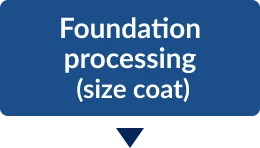
Also known as a "size coat," this treatment is applied to improve adhesion with subsequent coating layers. It may sometimes be omitted.

The exterior is given a colored base coat to serve as a foundation for the design, while the interior may be coated with varnish. Coating specifications vary depending on the product.

The design is printed onto the sheet.

A varnish is applied to the surface for protection and to provide a glossy finish.

If cutting is required, the printed aluminum sheet is cut to size to match the subsequent cap-forming process.
Forming process

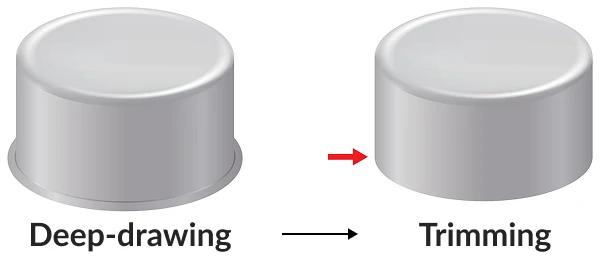
The printed sheet is formed into a hat shape, and the edges are trimmed. Depending on the product, deep drawing and trimming may be performed as separate steps.

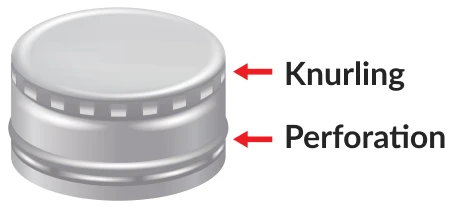
To prevent slippage when opening the cap, a knurled pattern is formed on the side walls. In addition, perforations are added so that it is immediately apparent when the cap has been opened.
Knurling and perforation are performed simultaneously.

An inner liner (resin) is attached to improve sealing against the container opening. Depending on the product, the liner may or may not be bonded to the inner surface of the cap.